UK · England · North Yorkshire · Craven · Market town
Settle
Solve eight clues hidden in the town's real buildings, and find the dungeon under the market. Climb a crag that was once a giant sundial, and collect a stamp at every stop.
Play the treasure hunt Plan your day Where am I? The map
A market town under a limestone crag. Settle has held a market on Tuesdays since 1249, and its people have been writing about it for almost as long.
Listen on the way
The 7 true stories of the town trail, read by a storyteller. About 2 minutes.
Press it anywhere in Settle. The page finds the nearest true story, ready to play, and the nearest toilets, playground and café. Your phone works out where you are; the page sends your location nowhere.
Settle in a minute
Old pictures, read by a storyteller, with the words on screen. Every story retells an old book or newspaper on this page.
The pictures
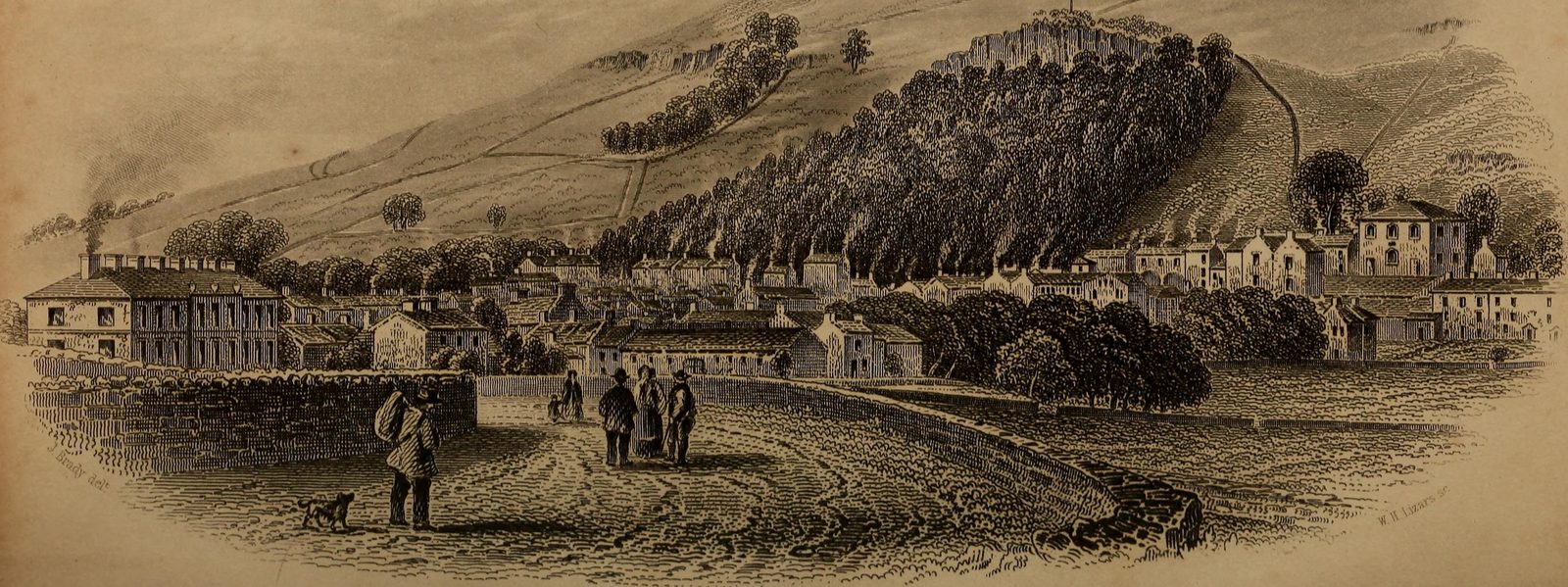
- Settle, from the South. William Howson, An Illustrated Guide to the Curiosities of Craven (London: Whittaker; Settle: Wildman, 1850).
- Settle Market Place from Castleberg. Horner Photographic Studio. The Horner Photographic Collection, Museum of North Craven Life, Settle, SETCL : 2022.1.16.7. Licensed under a Creative Commons Attribution 4.0 International License.
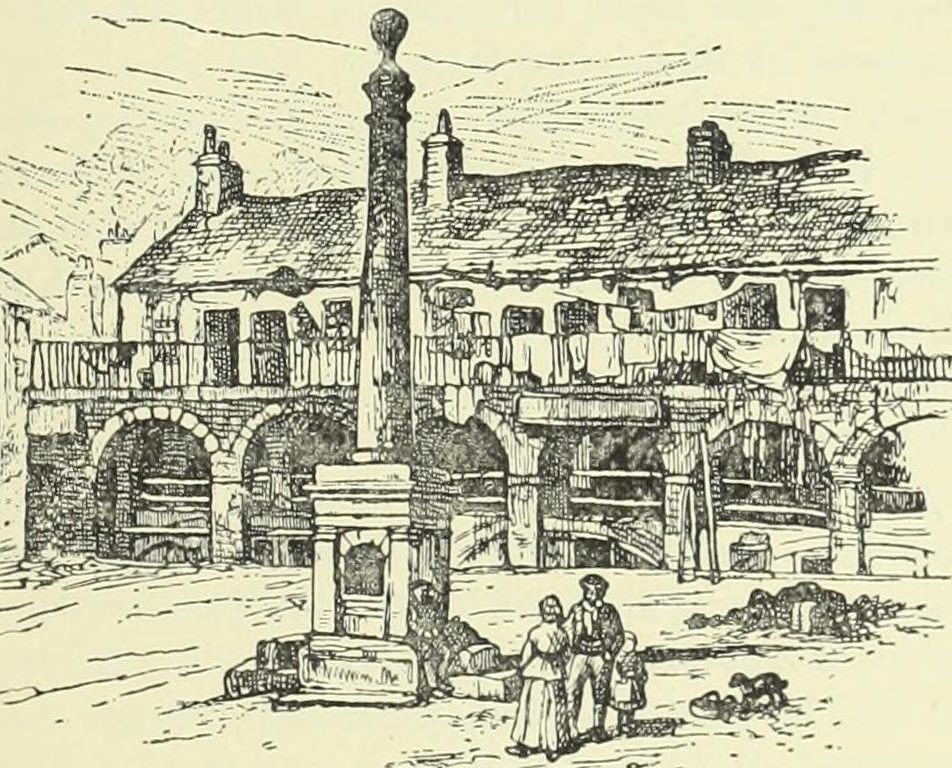
- Market Place, Settle. Harry Speight, The Craven and North-West Yorkshire Highlands (London: Elliot Stock, 1892).
- Sheep market in the Market Square, Settle. Horner Photographic Studio. The Horner Photographic Collection, Museum of North Craven Life, Settle, SETCL : 2022.1.57.9. Licensed under a Creative Commons Attribution 4.0 International License.
- The Folly, Settle. Horner Photographic Studio. The Horner Photographic Collection, Museum of North Craven Life, Settle, SETCL : 2022.1.35.2. Licensed under a Creative Commons Attribution 4.0 International License.
- Settle in 1822. Harry Speight, The Craven and North-West Yorkshire Highlands (London: Elliot Stock, 1892).
- Mill workers in shawls, Market Square, Settle. Horner Photographic Studio. The Horner Photographic Collection, Museum of North Craven Life, Settle, SETCL : 2022.1.37.12. Licensed under a Creative Commons Attribution 4.0 International License.
Coming up
Christmas lights switch-on
Saturday 28 November, from 12pm in the Market Place. A bouncy castle, a treasure hunt, children's games and Santa's grotto. Fireworks and the switch-on are at 5pm. Source
How long have you got?
The lost dungeon of Settle: a treasure hunt
Eight clues, all things you can see in the town today, lead you to stand on top of a dungeon nobody has seen for over 150 years.
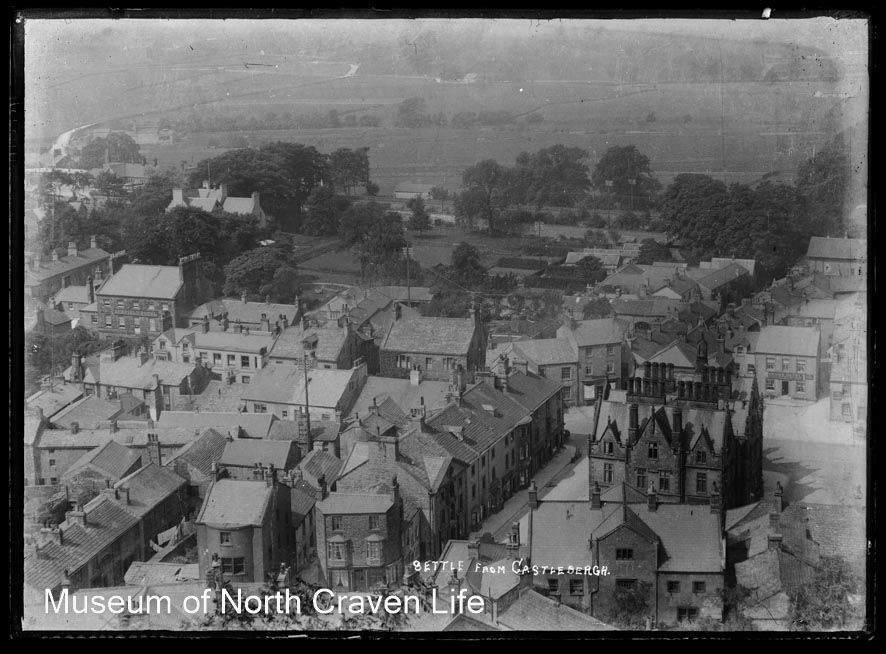
A photographer from the Horner studio in Settle took this from the top of Castleberg, more than a hundred years ago. Stand where the photographer stood. What has changed?
Climb the crag that was a giant sundial
A zigzag path climbs to the top. Long ago, the rock's shadow told the whole town the time.
Play or read the true story
The top of Castleberg, the rock above Settle, was once part of a huge sundial. Its shadow moved across big stones on the hillside, and told the town the time. The stones were taken away long ago, and trees grow there now.
This story comes from Thomas Dunham Whitaker, writing in 1805, and William Howson, writing in 1850.
When you get there Climb to the top and look down on the town. Then look at your own shadow. Which way would the rock's shadow fall now?
“Within the last century the peak of Castleberg formed the gnomon of a huge sun dial, whose hours were marked along the hill side by large stones ; these have been long removed, and the plantations occupy their site.”
Find the Black Hole, the Naked Man and the dogs' fountain
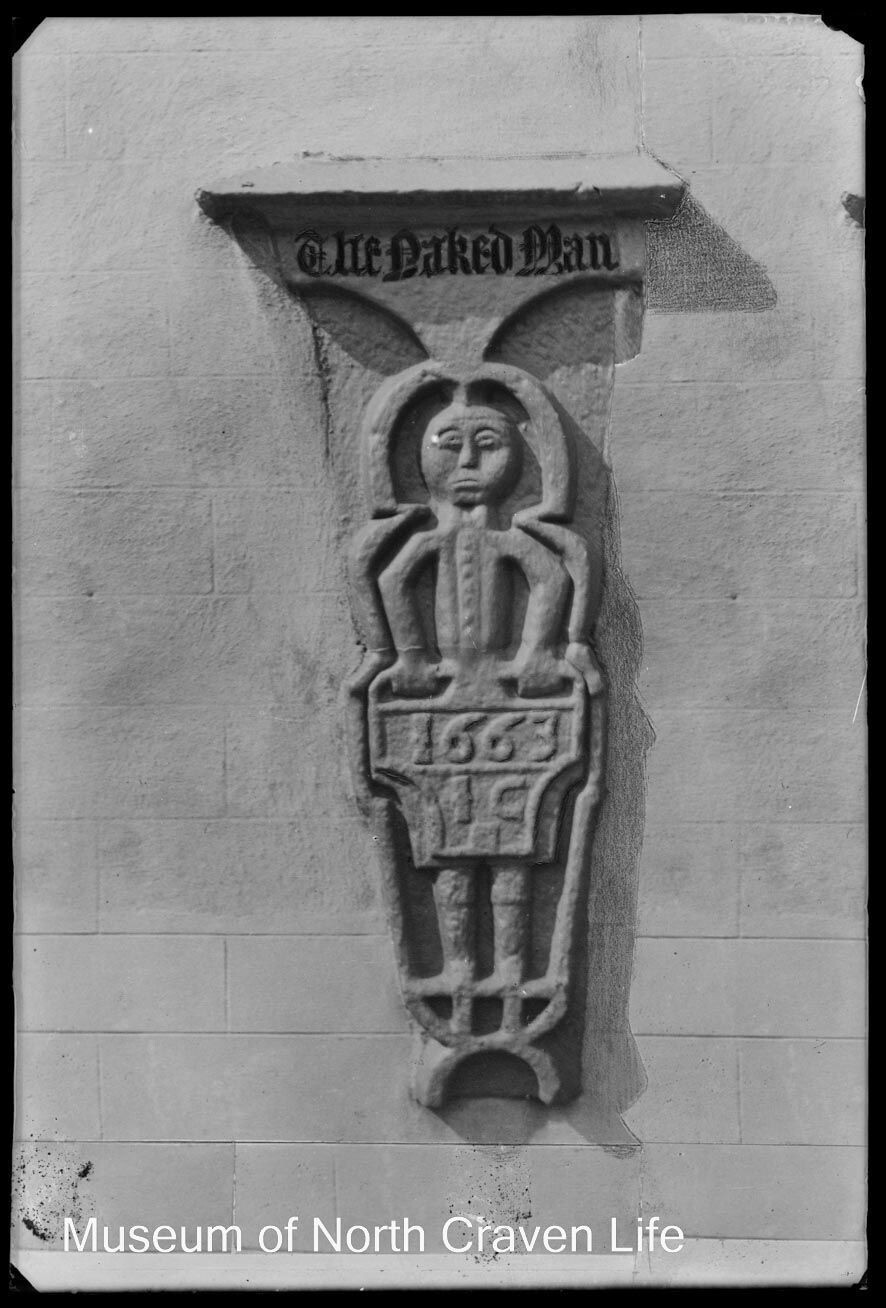
A dungeon once lay under the market cross. A stone man has held up his date since 1663.
Play or read the true story
Under the old market cross there was a dungeon called the Black Hole. You went down a flight of steps into it. A newspaper of 1863 said it was a terror to naughty children. The town filled it in, and put up a drinking fountain near the spot. Low down on the fountain are little troughs of water, so that dogs can have a drink too.
This story comes from the Settle Chronicle, in 1863, and Harry Speight, writing in 1892.
When you get there Find the fountain and its troughs for dogs. Then look round the square for a stone man holding a sign. What year is carved on it?
“The old Jail, or Black Hole, was a wretched underground dungeon entered by a flight of steps at the foot of the cross, and which thirty odd years ago, stood between the present Fountain and the Town Hall. It was then filled up and the road macadamised, so that its presence is not now discernible.”
Pull the levers in the old signal box
Volunteers let children pull the real levers, and the signals outside move.
Most Saturdays, 10am to 4pm. It shuts on the Saturdays nearest Christmas Day and New Year's Day, and on any Saturday when no trains call at Settle.
Play or read the true story
In 1876 men called navvies were building the railway here. At dinner time they lay down on big piles of timber in the station yard, and slept. A visitor wrote that they snored like rich men in feather beds. Out on the boggy moor, wheels sank, so the navvies sent food and bricks on a cart that rolled along on a barrel. Sometimes the horses pulling it sank up to their middles, and had to be pulled out by their necks.
This story comes from Frederick S. Williams, writing in 1876.
When you get there If the signal box is open, climb its steps and pull a lever. Watch which signal moves.
See the giant screw that makes electricity
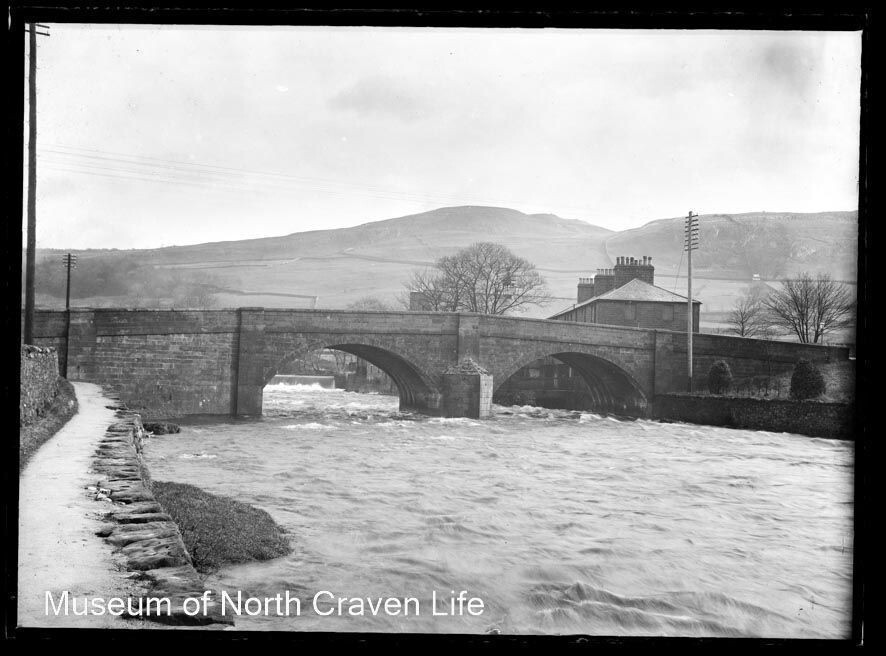
A screw 7.77 metres long turns in the River Ribble. Salmon climb the fish pass beside it.
Play or read the true story
Stand on the bridge and look up the valley. The big hill you can see up the valley is Pen-y-ghent. A man called Paley is said to have thought it looked like a huge plum cake. Another old book says he called it a raised pie. One half of this bridge is very old. It has three ribs of stone under its arch. The other half was added later, and its stones are flat.
This story comes from Murray's Handbook for Travellers in Yorkshire, in 1867, William Howson, writing in 1850, and Harry Speight, writing in 1892.
When you get there Look downstream for the weir and the giant screw beside it. It turns to make electricity from the river. Is it turning today?
“When the church was built, the old bridge over the Ribble was widened, the eastern or older portion shewing three arched "ribs" of single blocks of grit ... while the western or new half of the bridge has ordinary flat masonry.”
Walk the town trail and collect seven stamps
Seven stops, each with a true story to read aloud or play, and a stamp to collect on the phone.
Play: Bond Lane play area and the pump track
Bring scooters or bikes for the pump track. There are picnic tables beside it.
Lunch in The Folly's coffee house
Children's meals, toilets and baby change, in a house built in the 1670s.
Monday to Saturday, 10am to 4pm. Closed on Sundays.
Play or read the true story
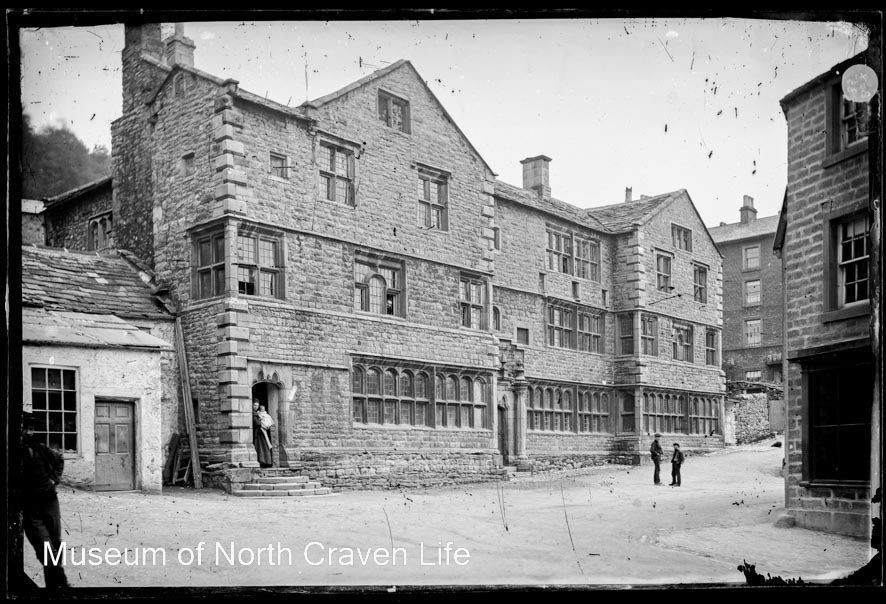
A family called Preston built this great house, but they never finished it. Harry Speight wrote in 1892 that the money ran out. That, he said, is why it has a tell-tale name: the Folly. Inside, he wrote, there is a panelled room with a secret passage.
This story comes from Harry Speight, writing in 1892, and J. Radford Thomson, writing in 1879.
When you get there The house has a very large number of windows. Count the windows on the front.
“At the top of the town, and just below Castleberg, is a remarkable old stone house bearing the date 1679, with a very large number of mullioned windows ... The house is now the dwelling of a farmer, and has certainly fallen from its former splendour.”
Swim, or ride the Spike Island inflatable
Public swims cost £4.00 for a child aged 4 to 15. The inflatable runs on the first Saturday of the month in term time, and in the school holidays.
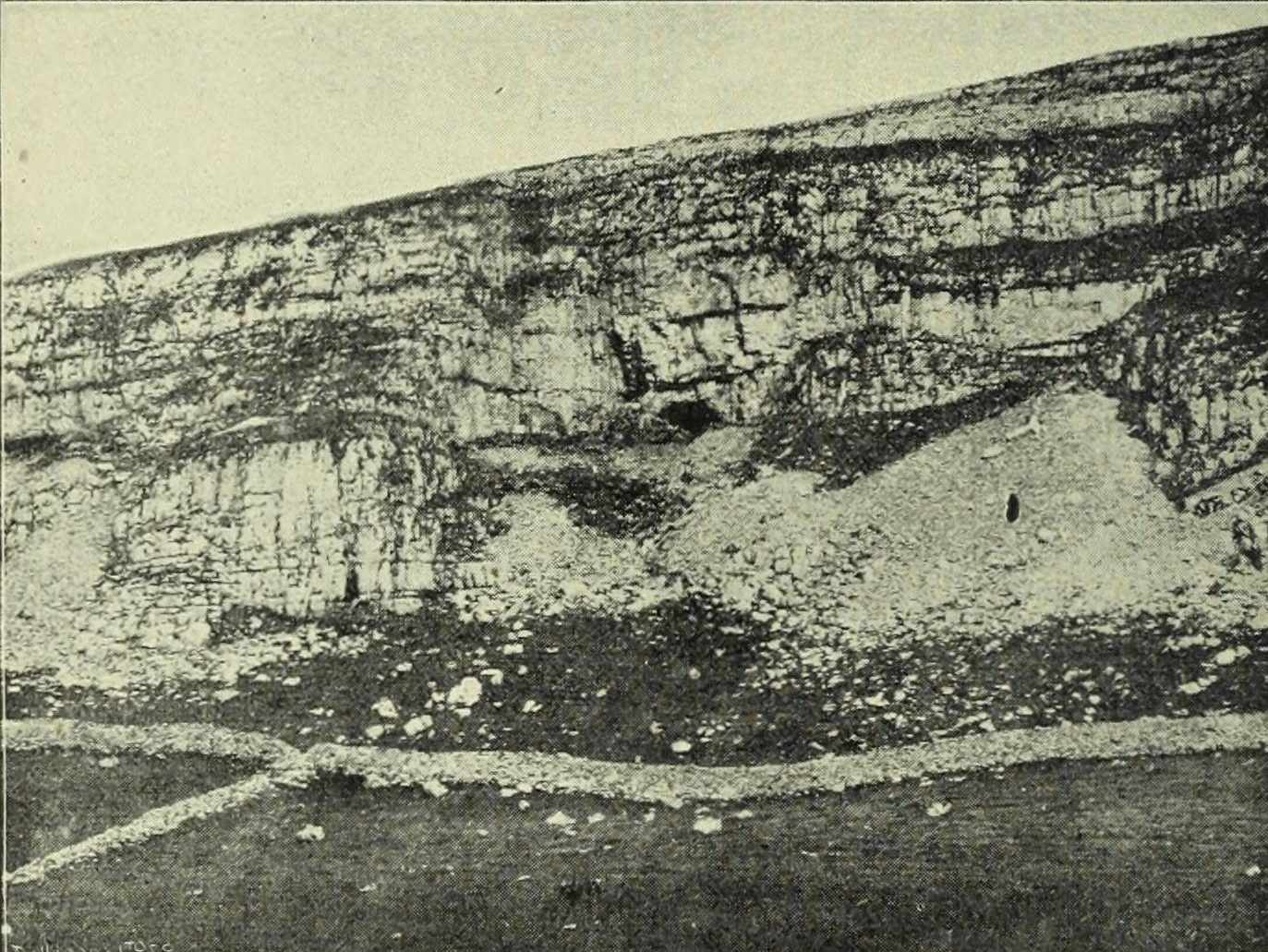
Walk up to Victoria Cave
A dog found the cave. Diggers found the bones of hippos and hyenas inside.
The times are our suggestion. Each story retells an old book or newspaper, and the quotes are word for word.
Playgrounds, toilets and cafésWith car parks and the station, nearest first, in minutes on foot from the Market Place
Playgrounds
- Playground, Commercial Street5 min
- Settle PlaygroundThe Bond Lane play area6 min
- Playground, Ingfield Lane9 min
Parks and gardens
Toilets
- Public toilets, Church StreetWhitefriars, 8am to 6pm every day2 min
- Public toilets, The SidingsAt the station, while the ticket office is open6 min
Cafés and ice cream
- The Waffle Cone1 min
- Car and Kitchen1 min
- 3 Peaks Cycles1 min
- Coffee in the Cave1 min
- Yorkshire Ice Cream1 min
- Attermire Café/Bar1 min
- Ye Olde Naked Man Cafe2 min
- The Wonky Cake Cafe2 min
- High Street Coffee2 min
- The Folly Coffee House2 min
- Miss Victoria’s Refreshment Gardens4 min
- the canteen7 min
- Settle Swimming Pool Cafe10 min
- Hector's Coffee Shop11 min
Picnic tables
- Picnic table, Bond Lane6 min
- Picnic table, Mitchell Lane10 min
- Pinfold10 min
Station
- Settle6 min
Car parks
- Whitefriars Car Park2 min
- Ashfield Car Park4 min
- Greenfoot Car Park4 min
Indoors
- Settle Community Library6 min
- Settle Station Signal BoxMost Saturdays, 10am to 4pm, free7 min
- Settle Area Swimming Pool10 min
From OpenStreetMap contributors, read on 2026-11-24. A place with no name on the map is named here by what it is and its street.
Before you goTrains, parking, toilets, playgrounds and market day
By train
About an hour from Leeds. Northern says trains run every two hours, and the station is 6 minutes' walk from the Market Place. Source
By car
Three council car parks. Greenfoot is cheapest for a full day, at £3.50. Source
Toilets
Whitefriars, off Church Street, open 8am to 6pm every day, with disabled facilities. Source
Playgrounds
Three play areas run by the town council, at Town Head, Commercial Street and Bond Lane, and a pump track for bikes and scooters. Source
Free to do
Climbing Castleberg, the signal box at the station, the river and the giant screw at the weir. Source
Market day
Tuesday. There is no market on a Saturday. An artisan market fills the square on the second Sunday of each month. Source
We read each source on 24 and 25 November 2026. Times and prices change, so check before you go.
The town trail
A dungeon under the market, a sleeping navvy, a rock that was a sundial, and lightning in church. 7 stops, 2.4 miles · 66 m climb · about 53 min. At each stop there is a true story to read aloud, and a stamp to collect in your book.
Old Settle, from the museums
Settle's own photographers, the Horners, took these pictures in the town more than a hundred years ago. The Folly keeps their glass plates. Go and stand where they stood, and find what is still there.
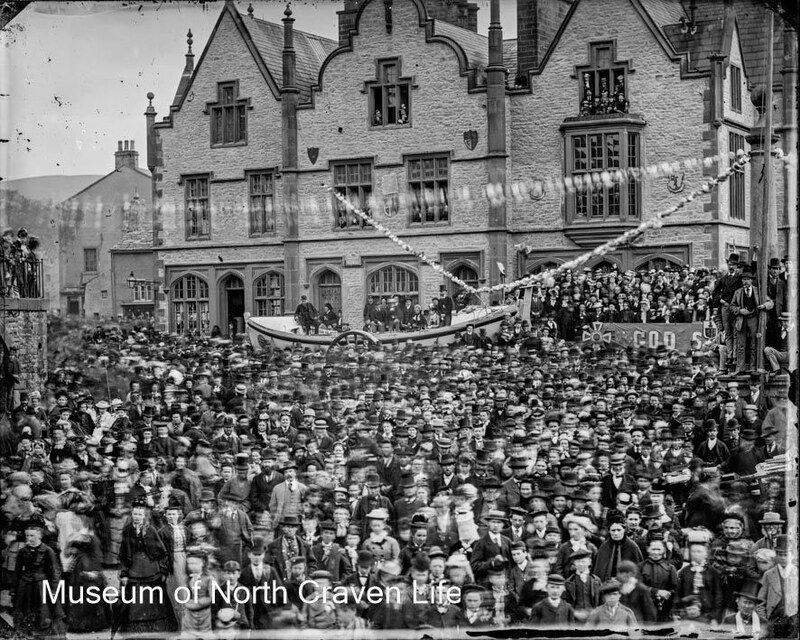
The day a lifeboat came to the Market Place
20 May 1875. Stand here: Market Place
Look closely Stand in the Market Place and face the big building with the pointed gables. On 20 May 1875 a lifeboat stood in front of it, and the whole square filled with people. Can you find the top window where people leaned out to watch?
Horner Photographic Studio. SETCL : 2022.1.4.4, the Horner Photographic Collection, Museum of North Craven Life. CC BY 4.0
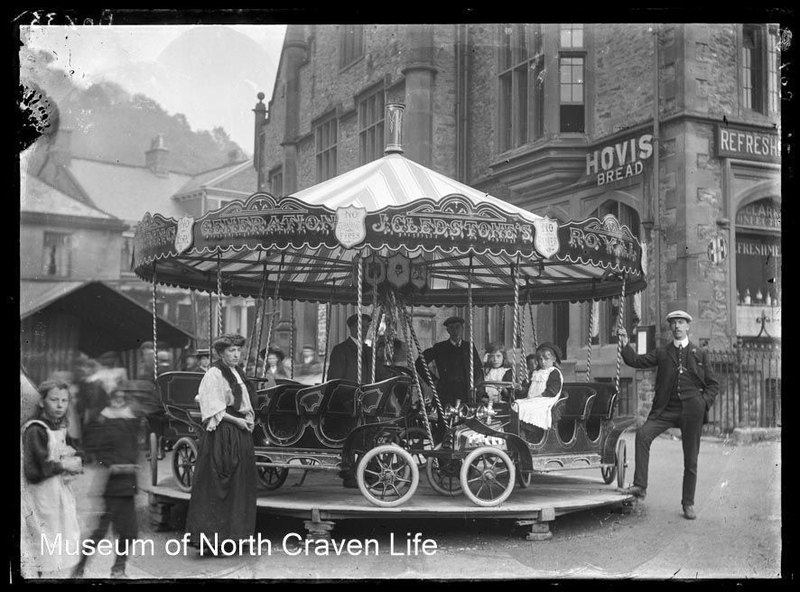
The fair comes to the Market Place
about 1875 to 1925. Stand here: Market Place
Look closely Stand in the Market Place and picture a fair here. In this photograph a roundabout stands in the square, with a little toy car among its seats. Three children sit on the ride. Which seat would you choose?
Horner Photographic Studio. SETCL : 2022.1.36.7, the Horner Photographic Collection, Museum of North Craven Life. CC BY 4.0
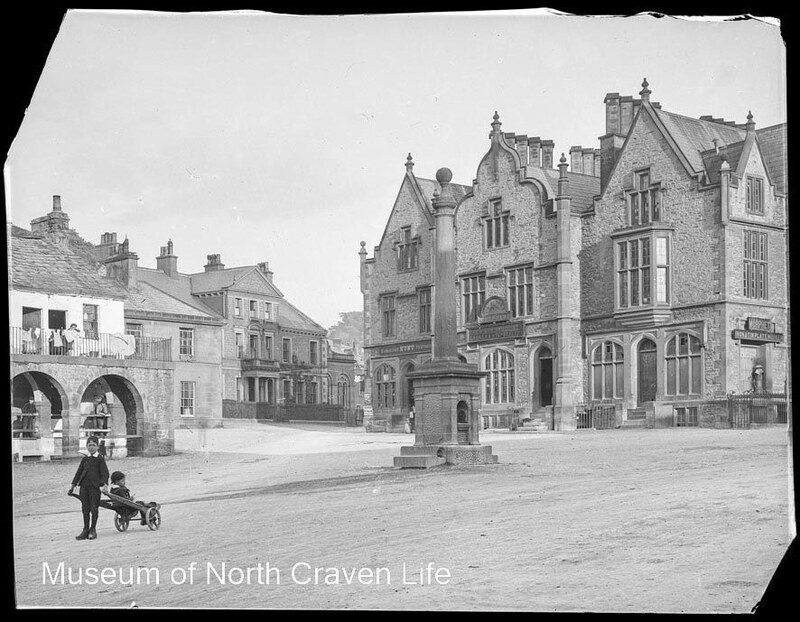
A boy with a cart in the Market Place
about 1875 to 1925. Stand here: Market Place
Look closely Find the tall stone pillar with a ball on top. In the photograph a boy pulls a little child past it in a small cart, in front of the arches of the Shambles.
Horner Photographic Studio. SETCL : 2022.1.44.24, the Horner Photographic Collection, Museum of North Craven Life. CC BY 4.0
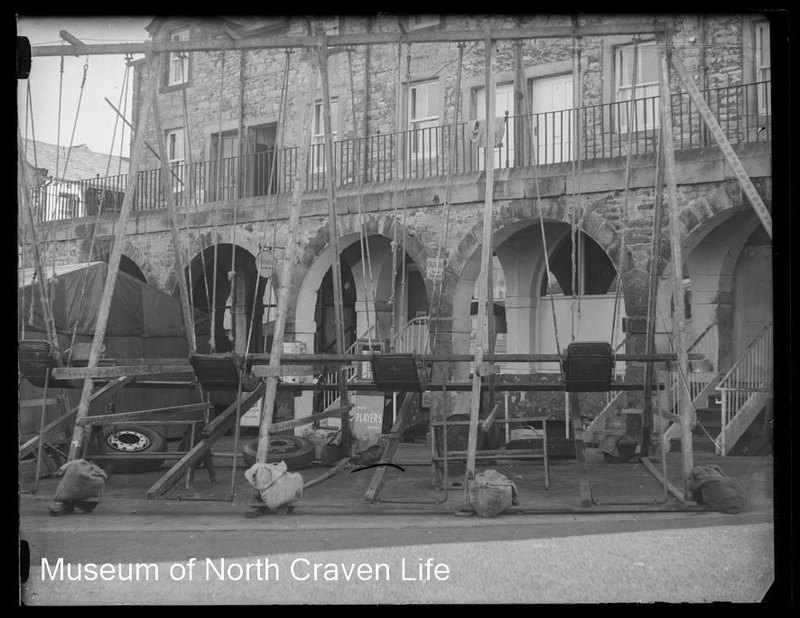
Swing boats in front of the Shambles
about 1875 to 1925. Stand here: The Shambles
Look closely Stand in front of the Shambles and count its arches. In this photograph a row of swing boats hangs in front of them, with nobody on them yet.
Horner Photographic Studio. SETCL : 2022.1.46.2, the Horner Photographic Collection, Museum of North Craven Life. CC BY 4.0
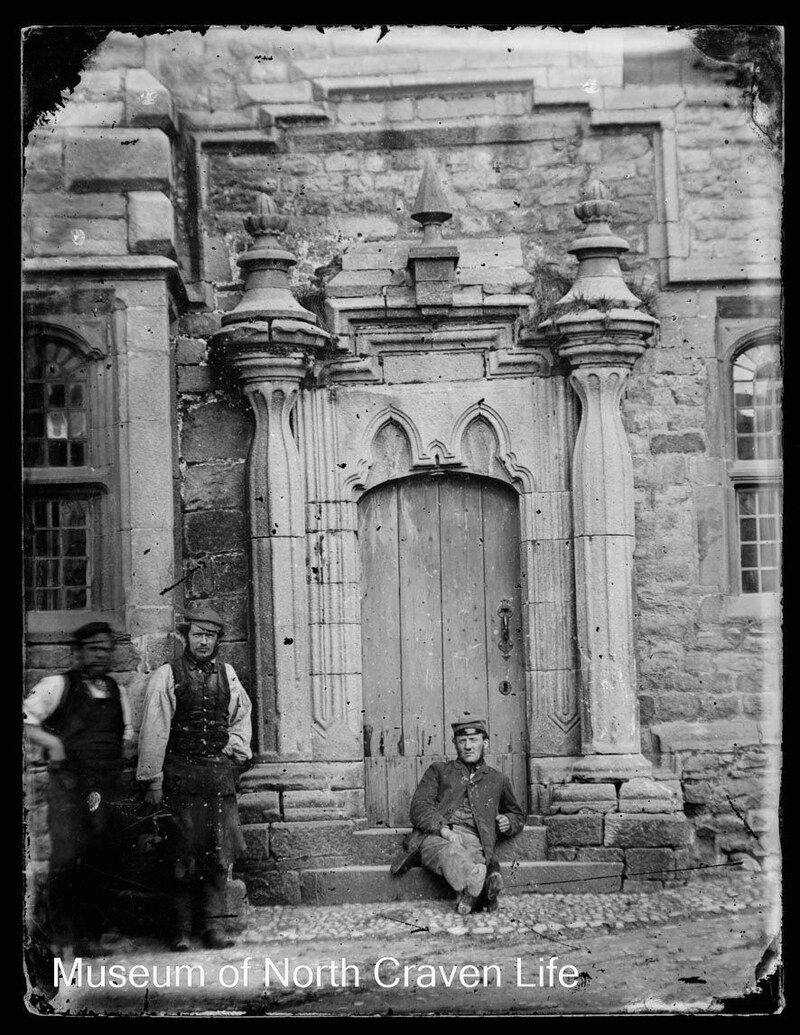
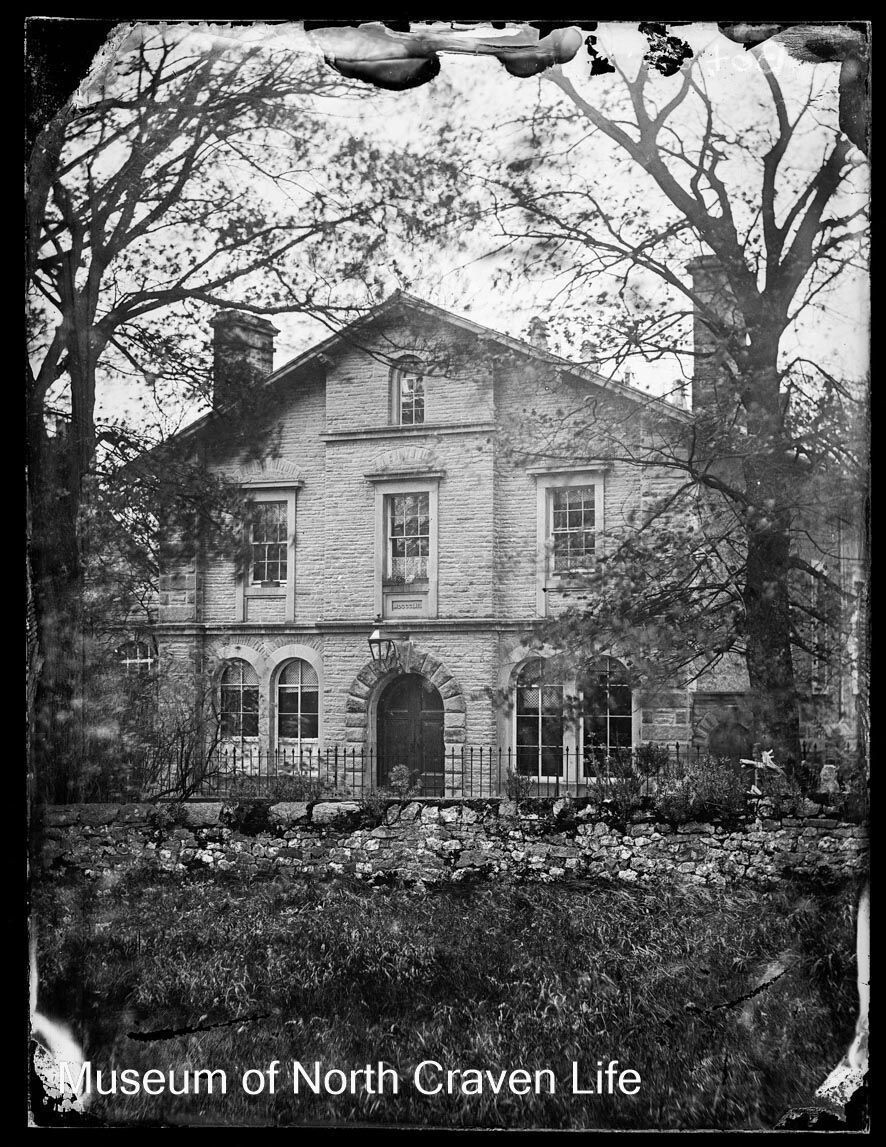
Three men on the Folly's steps
before about 1885. Stand here: The Folly
Look closely Stand at the Folly's front door and look at the carved stone pillars on each side of it. In the photograph one man sits on the step and two stand beside him. Can your family pose the same way?
Horner Photographic Studio. SETCL : 2022.1.68.102, the Horner Photographic Collection, Museum of North Craven Life. CC BY 4.0
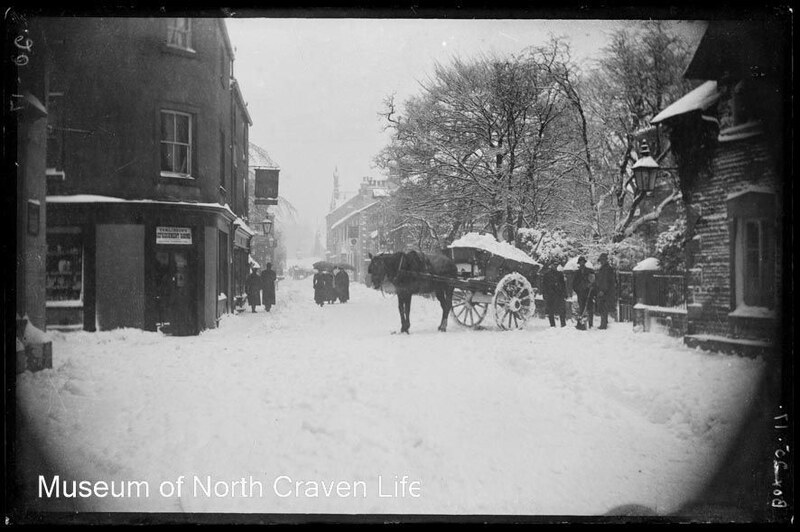
Duke Street in the snow
about 1875 to 1925. Stand here: Duke Street
Look closely Walk along Duke Street. In this photograph deep snow covers the street, and a horse and cart stand outside Tomlinson's Refreshment Rooms while people in long coats walk up the street.
Horner Photographic Studio. SETCL : 2022.1.37.11, the Horner Photographic Collection, Museum of North Craven Life. CC BY 4.0
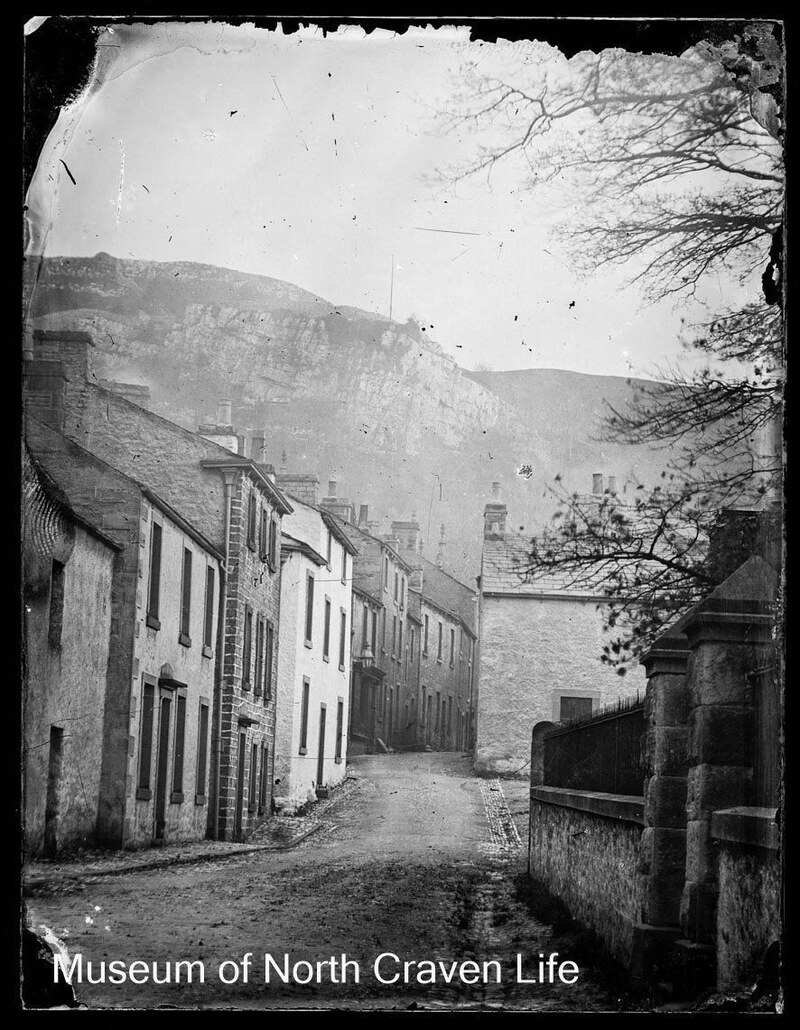
Kirkgate, under the crags
before about 1885. Stand here: Kirkgate
Look closely Walk along Kirkgate and look up above the roofs. In this photograph a long rocky crag rises over the houses, and a big square stone gatepost stands beside the lane.
Horner Photographic Studio. SETCL : 2022.1.8.36, the Horner Photographic Collection, Museum of North Craven Life. CC BY 4.0
Kept in other museums
These museums have no pictures online, so here are their own words about each thing.
Horses and carts passing the Naked Man
Dales Countryside Museum, Hawes, late Victorian. Stand here: The Naked Man
“Large black-and-white photograph of the main street in Settle with horse-drawn vehicles, including a caravan, carts and carriages, passing the Naked Man Hotel and Dawson's Furnishing and General Ironmongery store, late Victorian”
Look closely Stand by the Naked Man. The Dales Countryside Museum has a late Victorian photograph of horses pulling a caravan, carts and carriages along this street, past the Naked Man Hotel and Dawson's ironmongery store.
Data courtesy of Dales Countryside Museum via museumdata.uk. Licensed under CC BY.
A sundial on the slope
Dales Countryside Museum, Hawes, 1778. Stand here: Market Place
“Copy of a large engraving showing the unusual sun dial constructed on the grassy slopes beneath the crags opposite the Market Place of Settle, 1778”
Look closely Stand in the Market Place and look across at the crags, and the grassy slope beneath them. The Dales Countryside Museum has a copy of an engraving from 1778 that shows an unusual sundial on that slope.
Data courtesy of Dales Countryside Museum via museumdata.uk. Licensed under CC BY.
Inside Settle
Points of interest within the town and its parish, each with what the old writers said about it.
- Market Place3 sources, 1863 to 1892
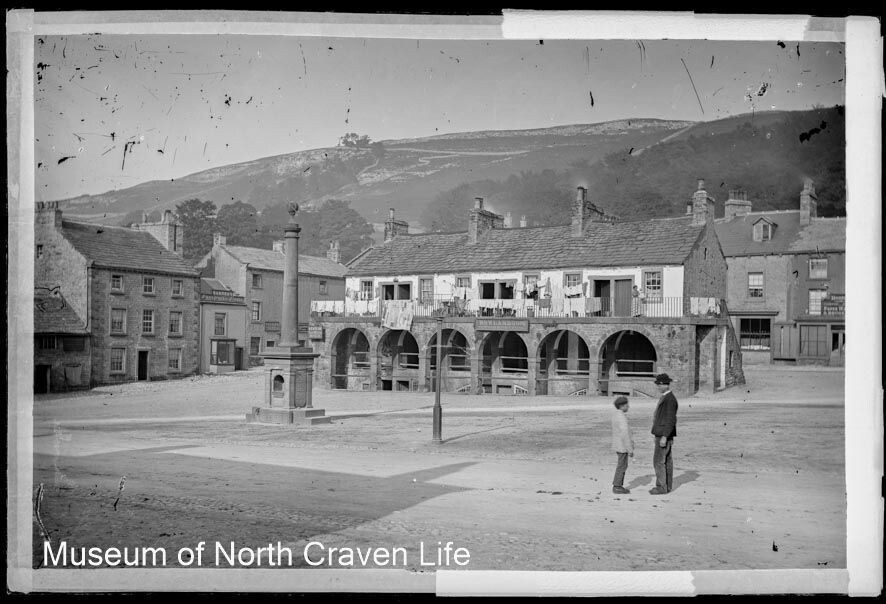 The Shambles1 source, 1856
- The Naked Man3 sources, 1854 to 1892
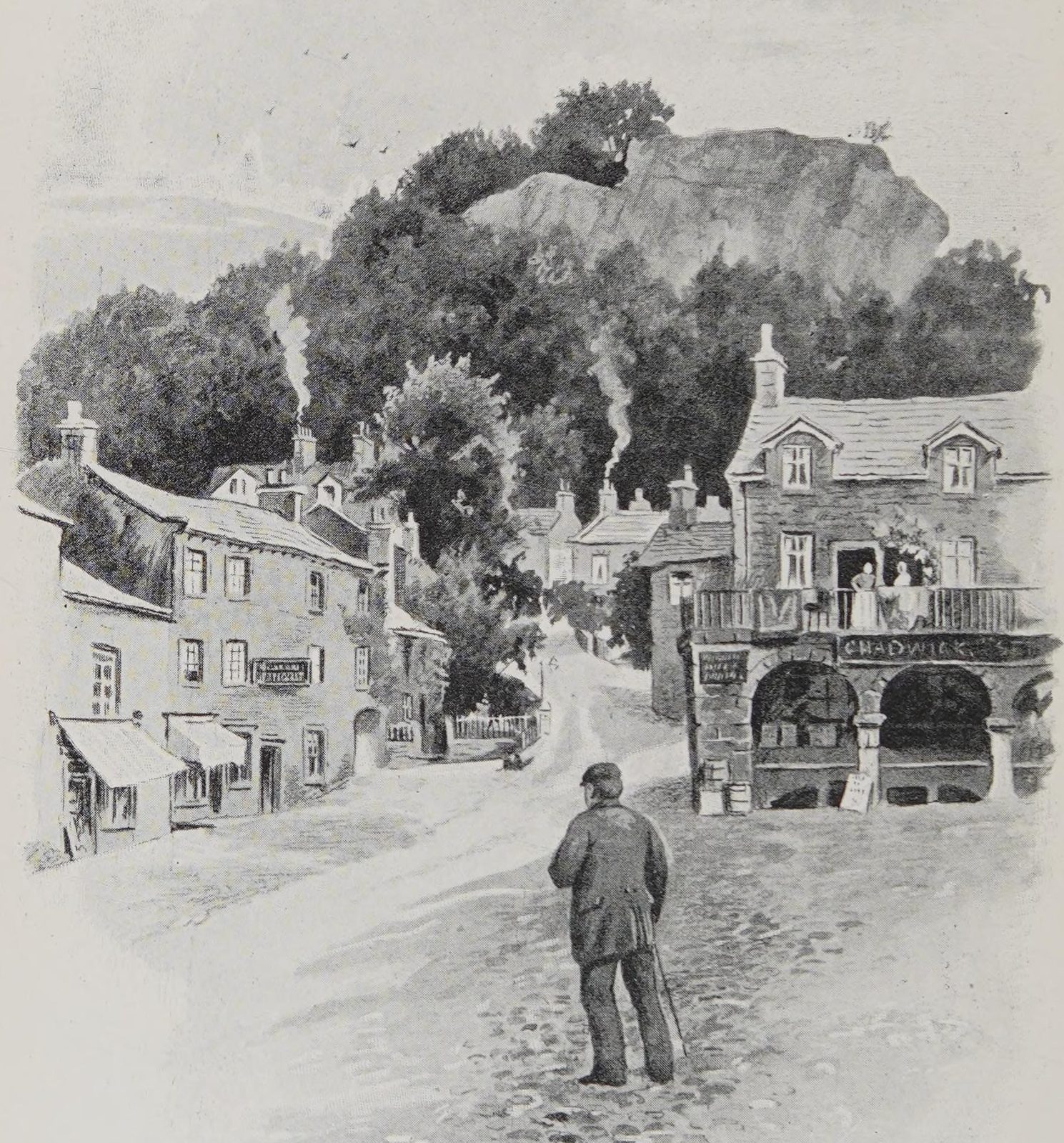 Castleberg7 sources, 1773 to 1892
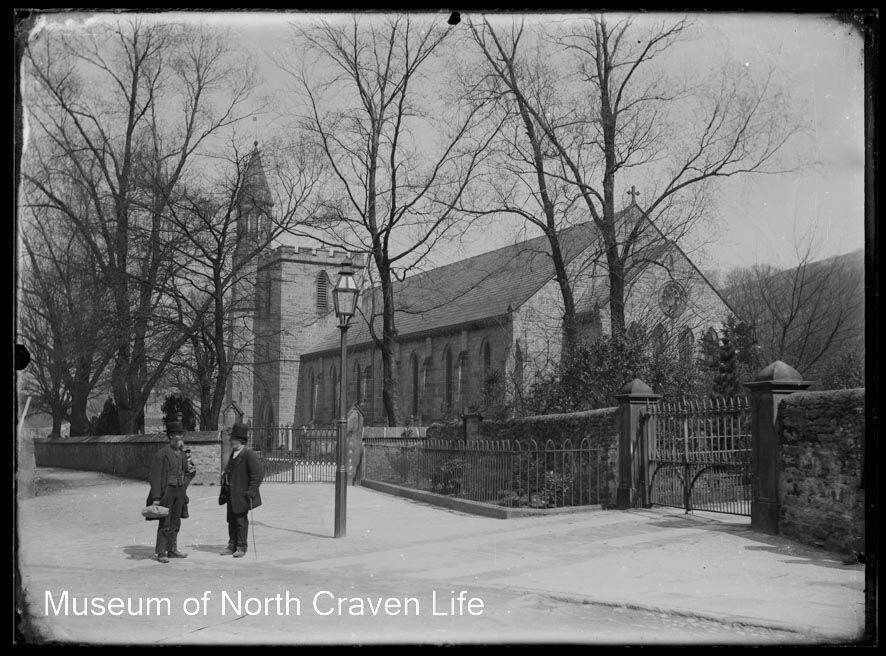 Holy Ascension Church3 sources, 1856 to 1892
- The Folly2 sources, 1879 to 1892
- Victoria Hall2 sources, 1854 to 1866
- Settle station2 sources, 1876
- Settle Bridge2 sources, 1867 to 1892
 Kings Mill1 source, 1854
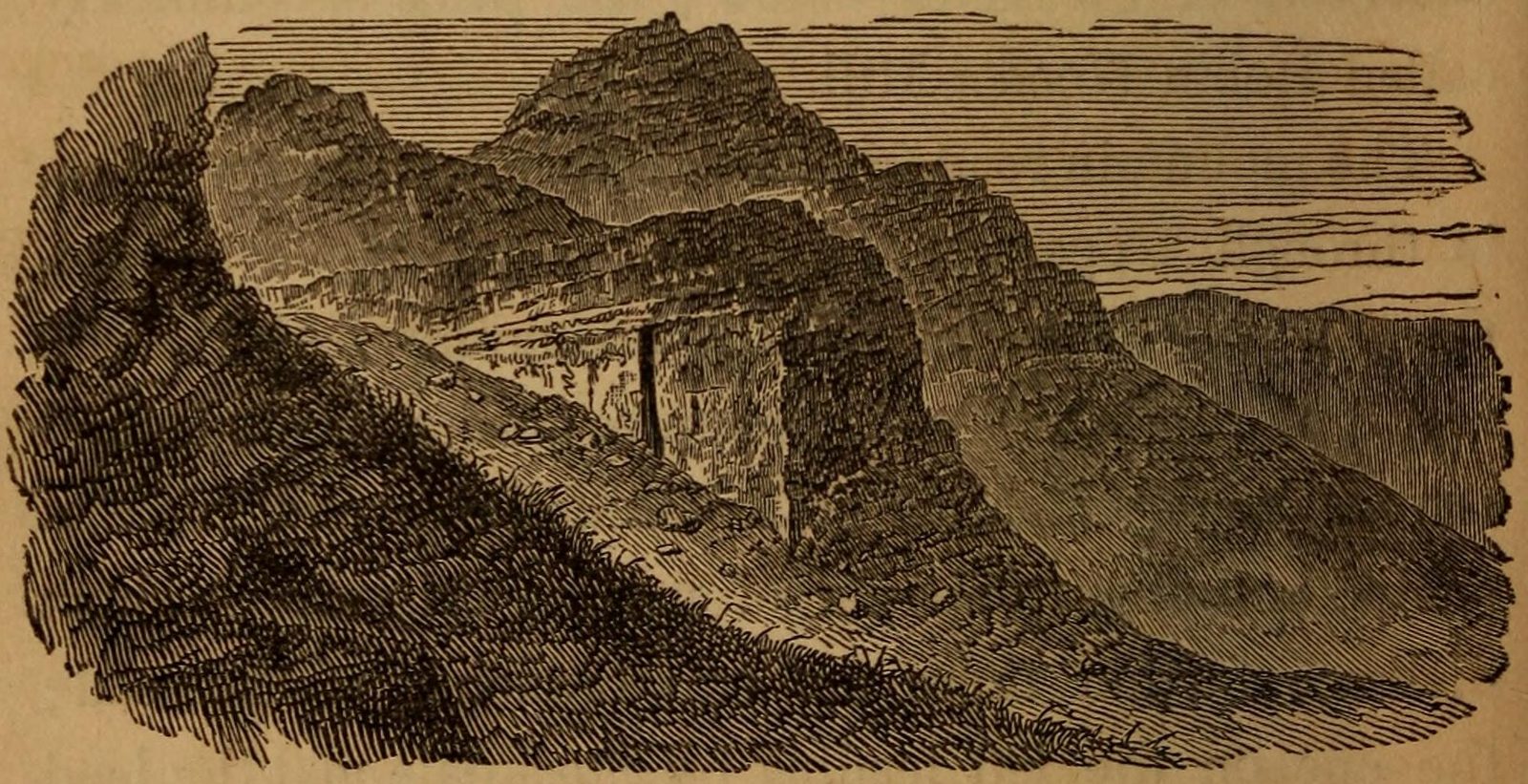 Attermire Scar5 sources, 1800 to 1902
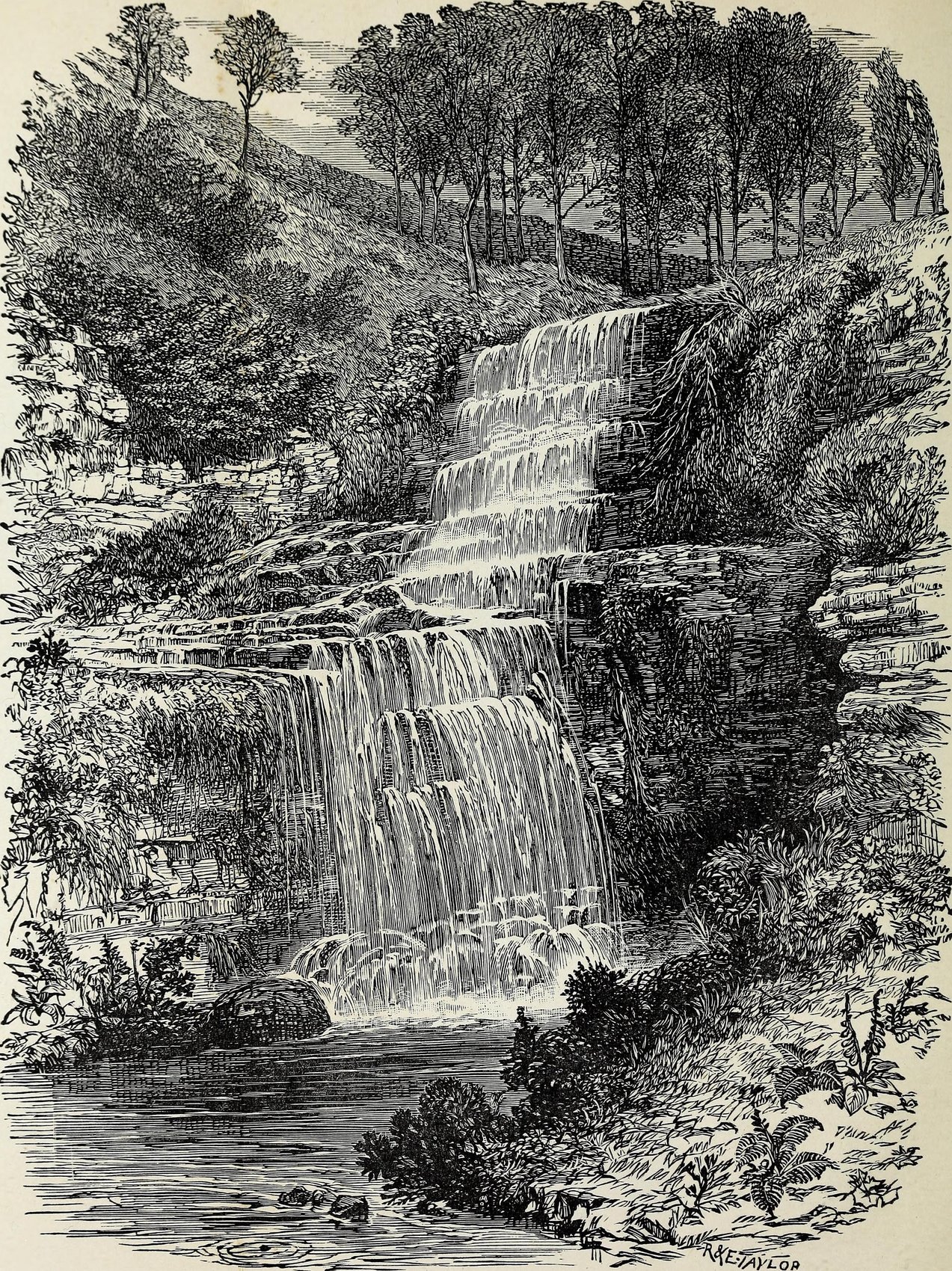 Scaleber Force5 sources, 1850 to 1892
If it rainsThe pool, the signal box, the library and a café
Settle Area Swimming Pool
Public swims cost £4.00 for a child aged 4 to 15. On the first Saturday of the month in term time, and in the school holidays, there is a giant inflatable called Spike Island. Book it ahead. Source
Settle station signal box
Open most Saturdays, 10am to 4pm. Free. The stairs are steep, and there is no wheelchair access. Source
Settle Community Library
Open on Saturday mornings, 10am to 12.30pm, next to Greenfoot car park. Source
The Folly Coffee House
Open Monday to Saturday, 10am to 4pm, with children's meals. The Museum of North Craven Life upstairs is closed until 2027. Source
Go further
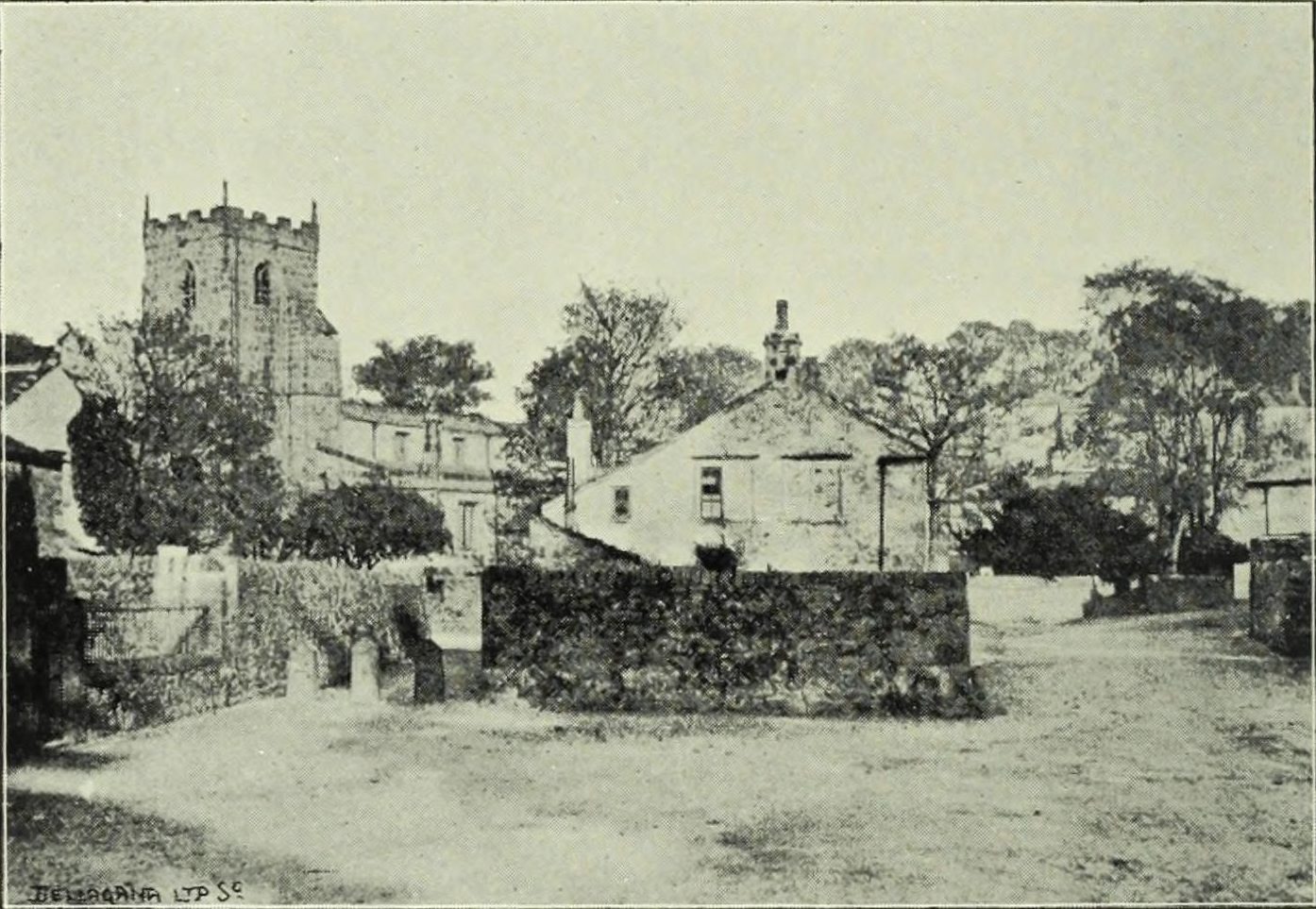 Giggleswick0.5 miles away as the crow flies. Over the bridge. Beside the road to Clapham is the Ebbing and Flowing Well, which old writers say rises and falls by itself.
- Victoria Cave1.4 miles away as the crow flies. A steep walk up the hill behind Settle. A dog found the cave in 1837, and diggers found the bones of hippos and hyenas.
- Scaleber Force1.5 miles away as the crow flies. A waterfall on the hill above the town.
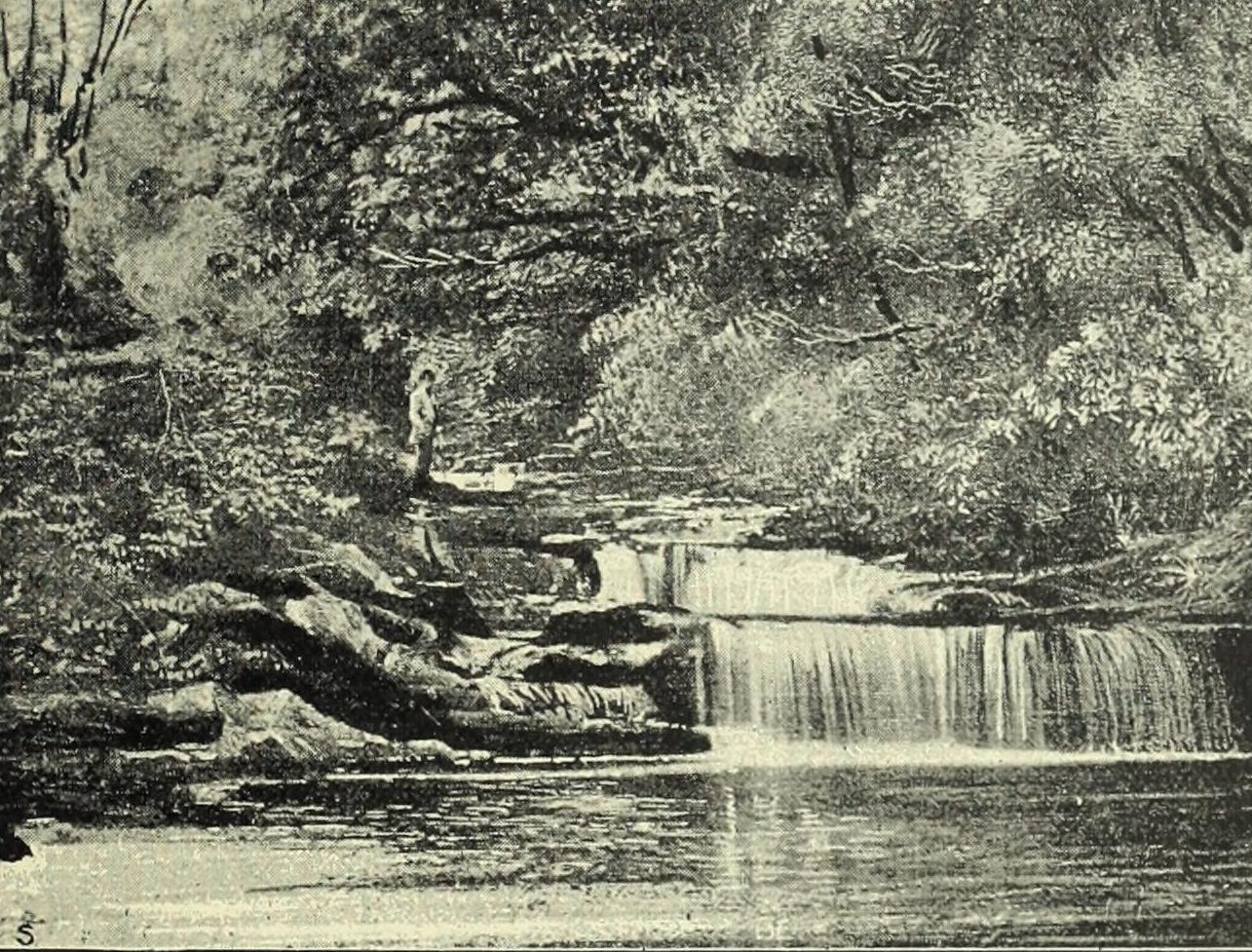 Stainforth Force2.1 miles away as the crow flies. Waterfalls on the Ribble, a few miles north, where salmon leap in the autumn.
What the writers said about Settle
Read all 28
-
1086
“Manor. In Anele (Anley) Burun had three carucates of land to be taxed. In Setel three carucates to be taxed.”
Domesday Book, the Conqueror's survey of 1086, in Speight's English. See the page
Source and note
Harry Speight, The Craven and North-West Yorkshire Highlands (London: Elliot Stock, 1892), page 73.
Whitaker (1805, p. 124) calls carucates 'plowlands': land measured for the tax called the geld.
-
1249
“Grant to Henry de Percy, son of Richard de Percy, and his heirs of a weekly market on Tuesday at his manor of Setel”
Charter Rolls of Henry III, the royal grant, in the government's printed English summary. See the page
Source
Calendar of the Charter Rolls preserved in the Public Record Office, vol. I, Henry III, 1226-1257 (London: HMSO, 1906), page 340.
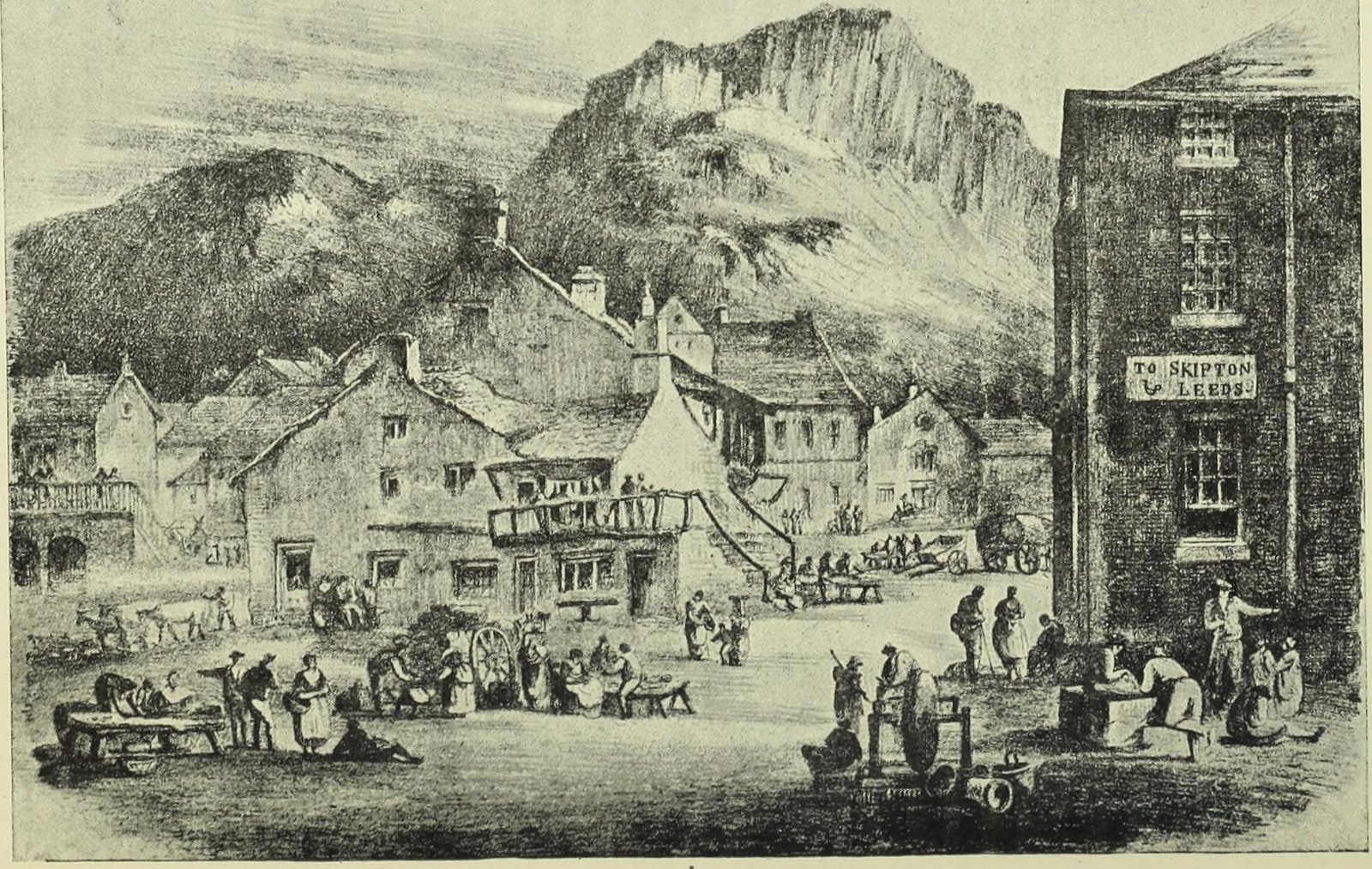
Settle in 1822. From Harry Speight, The Craven and North-West Yorkshire Highlands (London: Elliot Stock, 1892). See the page -
1651 · 11 August 1651
“We are this night with five of our best regiments of horse quartered at Settle-in-Craven, one hundred and forty miles from St. Johnston, where we were on Sunday seven-night.”
General John Lambert, Parliament's general, writing to the Council of State. See the page
Source
Harry Speight, The Craven and North-West Yorkshire Highlands (London: Elliot Stock, 1892), page 89.
-
1668
“William Taylor, in Setle ... I will exchaing my penny, 1668.”
A Settle trade token, a penny that a Settle tradesman struck when copper coin was short. See the page
Source
Harry Speight, The Craven and North-West Yorkshire Highlands (London: Elliot Stock, 1892), page 88.
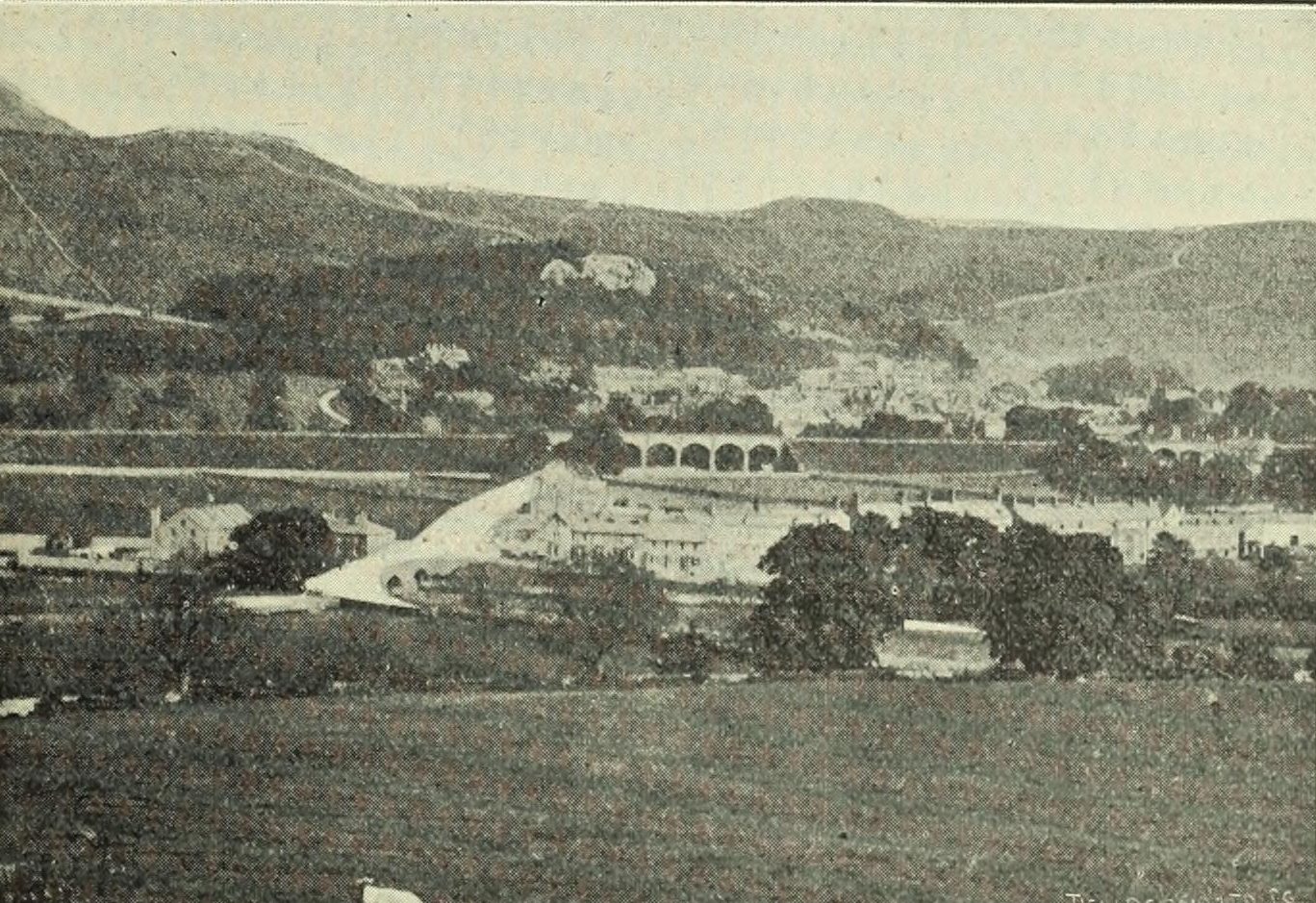
Settle from the West, A. Horner (photograph). From Harry Speight, The Craven and North-West Yorkshire Highlands (London: Elliot Stock, 1892). See the page -
1769 · 12 October 1769
“standing directly under a rocky fell, there are not a dozen good-looking houses, the rest are old and low, with little wooden Portico's in front”
Thomas Gray, poet, touring the north. See the page
Source
Thomas Gray, journal of his tour, 1769, in The Letters of Thomas Gray, ed. Duncan C. Tovey, vol. III (London: George Bell, 1900), page 261.
-
1773 · 1773 (printed 1801)
“Numbers of coiners and filers lived about the place, at this time entirely out of work, by reason of the recent salutary law respecting the weight of gold.”
Thomas Pennant, naturalist and travel writer. See the page
Source and note
Thomas Pennant, A Tour from Downing to Alston-Moor (London, 1801), page 111.
Speight (1892, p. 84) dates Pennant's visit to 1773.
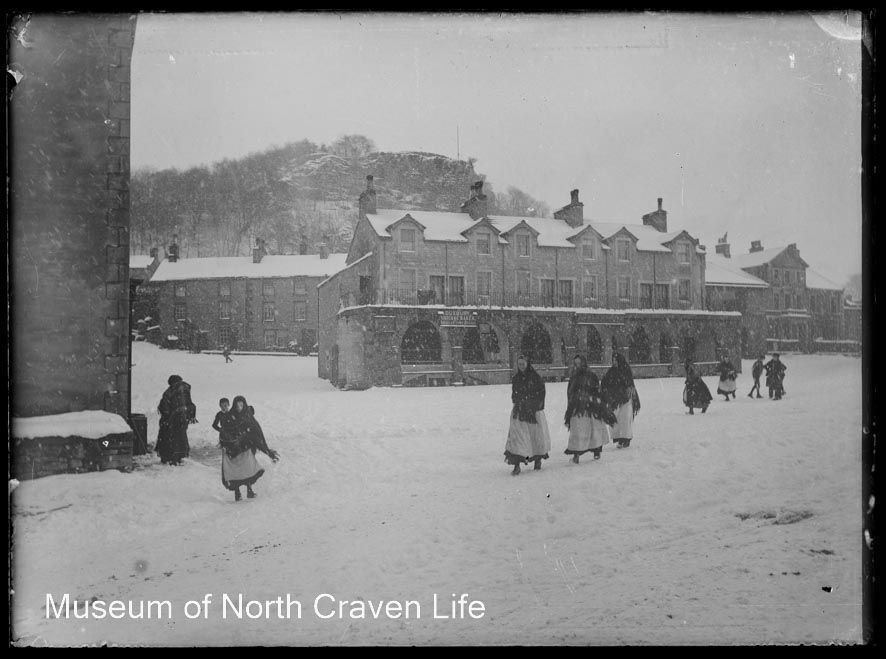
Mill workers in shawls, Market Square, Settle, Horner Photographic Studio, about 1875 to about 1925, Victorian. The Horner Photographic Collection, Museum of North Craven Life (The Folly), Settle. CC BY 4.0. See the work -
1773
“I dined here at the neatest and most comfortable little inn I ever was at, rendered more agreeable by the civility and attention of the landlady.”
Thomas Pennant, Welsh naturalist and travel writer, touring in 1773. See the page
Source
Thomas Pennant, A Tour from Downing to Alston-Moor (London: Edward Harding, 1801); the tour was made in 1773, page 111.
-
1773
“This is a market town, and has a small trade in knit-worsted stockings”
Thomas Pennant, Welsh naturalist and travel writer, touring in 1773. See the page
Source
Thomas Pennant, A Tour from Downing to Alston-Moor (London: Edward Harding, 1801); the tour was made in 1773, page 111.
-
1779
“Here the road turns north-west, which brought us to a place called Settle, a much better town than we expected in such a country.”
A Tour through the Island of Great Britain, the guide Daniel Defoe began in 1724, here in an edition that later editors continued. See the page
Source and note
A Tour through the Island of Great Britain, vol. 3 (1779 edition); 'originally begun by the celebrated Daniel De Foe, continued by the late Mr. Richardson'.
The words are the 1779 editors', not necessarily Defoe's own. We typed the long s as s. The link opens a search inside the scan, since its two columns are run together.
-
1800
“It stands near the base of a white limestone rock, called Castlebar, which some travellers say resembles that of Gibraltar ... The inhabitants have lately been at the expence of cutting an easy winding path to the top of it”
John Housman, writer of a guide for tourists. See the page
Source and note
John Housman, A Descriptive Tour, and Guide to the Lakes, Caves, Mountains, and Other Natural Curiosities (Carlisle, 1800), page 26.
The scan prints the long s. We put s. Housman spells Castleberg 'Castlebar'.
-
1805
“The summit of Castleberg once formed the gnomon of a rude but magnificent sun-dial, the shadow of which passing over some grey self stones upon its side, marked the progress of time to the inhabitants of the town beneath”
Thomas Dunham Whitaker, historian of Craven. See the page
Source
Thomas Dunham Whitaker, The History and Antiquities of the Deanery of Craven (London, 1805), page 122.
-
1850 · 11 May 1850
“THE ROMANTIC DISTRICT OF CRAVEN, YORKSHIRE ... CAVES AND WATERFALLS. Yordas, Thornton Force, Weathercoat, Stainforth Force, Clapham, Catterick, Attermire”
Preston Pilot, a newspaper, in the British Newspaper Archive's free search extract. See the page
Source and note
Preston Pilot, 11 May 1850, page 4; the words come from the free extract the British Newspaper Archive's search shows, page 4.
An advertisement in a Preston paper listing the sights of Craven.
-
1850
“"I was thinking," said the Dr., "how like Penyghent is to a raised pie"”
William Paley, the theologian, schooled at Giggleswick, looking up the valley from Settle Bridge. See the page
Source
William Howson, An Illustrated Guide to the Curiosities of Craven (London and Settle, 1850), page 51.
-
1854
Black American singers gave a concert in Settle's Music Hall in 1854.
This 1854 review uses a word for Black people that is offensive today. We quote it as the paper printed it, because it is the record. Why we quote old words
“A party of American Negroes "not painted," gave a novel species of Concert in the Music Hall, on Tuesday last, which was well attended. ... harmonized admirably, when joining together in the Choruses of their national melodies.”
Settle Chronicle, the monthly Settle paper. See the page
Source and note
The Settle Chronicle and North Ribblesdale Advertiser, 1854 volume. Scans held by the Museum of North Craven Life, published by the North Craven Building Preservation Trust (CC BY-NC-SA 4.0), page 16.
The paper called them the Sable Harmonists. It printed the review beside its report of Settle's April fair. The review also made remarks on the singers' looks, which we have not quoted. We read its "not painted" as setting these singers apart from white performers who blacked their faces.
-
1855 · 7 December 1855
“Mr. J. and E. A. Hopkins were the speakers. Mrs. Hopkins spoke for a long time, and her solemn and very interesting appeals, were listened to with great attention.”
Settle Chronicle, the monthly Settle paper. See the page
Source and note
The Settle Chronicle and North Ribblesdale Advertiser, 1856 volume. Scans held by the Museum of North Craven Life, published by the North Craven Building Preservation Trust (CC BY-NC-SA 4.0), page 3.
A public meeting of the Friends, as the Quakers call themselves. The paper printed it among its Settle news in January 1856 and gives nothing more about the Hopkinses.
-
1856 · November 1856
Mr Watson had escaped slavery in Kentucky. In 1856 he lectured near Settle on the education of Black people in Canada.
This 1856 report uses a word for Black people that is offensive today. We quote it as the paper printed it, because it is the record. Why we quote old words
“a Mr. Watson, an escaped Negro from Kentucky in the United ... delivered a Lecture on the education of the coloured ... of Canada, to a numerous audience”
Settle Chronicle, the monthly Settle paper. See the page
Source and note
The Settle Chronicle and North Ribblesdale Advertiser, 1856 volume. Scans held by the Museum of North Craven Life, published by the North Craven Building Preservation Trust (CC BY-NC-SA 4.0), issue of 1 December 1856, page 47.
The paper does not give his first name or say where he spoke. The item sits among the local news, under the heading 'Fugitive Negro Education'. 'Negro' is the paper's word.
-
1858
“There was nothing doing in the Market-place, its noisiest occupants being two cocks that were crowing defiance from opposite corners.”
Jeremy, a visitor writing in the Settle Chronicle, a walker whose series, Craven Reminiscences, ran in the town's paper under the name Jerry Daffelem. See the page
Source
The Settle Chronicle and North Ribblesdale Advertiser, 1858 volume, p. 13, 'Craven Reminiscences continued'. Scans held by the Museum of North Craven Life, published by the North Craven Building Preservation Trust under CC BY-NC-SA 4.0 (https://thefolly.org.uk/?p=3707), page 13.
-
1858
“there are a few cotton mills clacking about the neighbourhood; and you may smell out divers savoury oudours, pertaining to the leather trade.”
Jeremy, a visitor writing in the Settle Chronicle, a walker whose series, Craven Reminiscences, ran in the town's paper under the name Jerry Daffelem. See the page
Source
The Settle Chronicle and North Ribblesdale Advertiser, 1858 volume, p. 13, 'Craven Reminiscences continued'. Scans held by the Museum of North Craven Life, published by the North Craven Building Preservation Trust under CC BY-NC-SA 4.0 (https://thefolly.org.uk/?p=3707), page 13.
-
1860
James Watkins, in his own words, on English working men who said they knew what slavery was.
“Since I have been in England, I have often been surprised to hear working men declare that they, too, know what slavery is. ... All this is very different to being placed on the auction block, and knocked off to the highest bidder”
James Watkins, a man who escaped slavery in Maryland and lectured in England against it. See the page
Source and note
James Watkins, Struggles for Freedom; or the Life of James Watkins, Formerly a Slave in Maryland, U.S., nineteenth edition, Manchester, 1860. Text from Documenting the American South, University of North Carolina (marked No Copyright in US), page 39.
English workers told James Watkins that they knew slavery too. He answers that a worker can give notice and leave, and a slave cannot.
-
1860
James Watkins, in his own words, in the book he published in 1860.
“I resided in Birmingham for nearly two years before the arrival of my wife, and during that time addressed numerous very largely attended meetings both in that town and in many of the adjoining counties, as Warwickshire, Derbyshire, Lancashire, and Yorkshire”
James Watkins, a man who escaped slavery in Maryland and lectured in England against it. See the page
Source and note
James Watkins, Struggles for Freedom; or the Life of James Watkins, Formerly a Slave in Maryland, U.S., nineteenth edition, Manchester, 1860. Text from Documenting the American South, University of North Carolina (marked No Copyright in US), page 44.
James Watkins wrote his own life story. This edition came out a year before he spoke in Settle. He wrote that he was born on Abraham Ensor's plantation in Baltimore County, Maryland, about 1823.
-
1861 · August 1861
Five blind musicians from the York School for the Blind gave a concert in Settle in 1861.
“a concert in the Music Hall ... five blind musicians from the York School for the Blind ... the solos were ... left to the blind musicians”
Settle Chronicle, the monthly Settle paper. See the page
Source and note
The Settle Chronicle and North Ribblesdale Advertiser, 1861 volume. Scans held by the Museum of North Craven Life, published by the North Craven Building Preservation Trust (CC BY-NC-SA 4.0), issue of 2 September 1861, page 35.
The concert closed the day of the flower show. The paper says this was the musicians' second visit to Settle. It names the singers Miss Wilson and Messrs. Plowman, Hird and Hudson.
-
1861 · July 1861
“Requests her patrons to accept her sincere thanks for the encouragement with which she has been favoured since commencing the above business, and desires to announce that she has determined to open a Register Office for Servants. ... BRIDES' CAKES and FUNERAL BISCUITS made on the shortest notice.”
Mrs J. Robinson, in the Settle Chronicle, confectioner of Duke Street, Settle, in her own advertisement. See the page
Source and note
The Settle Chronicle and North Ribblesdale Advertiser, 1861 volume. Scans held by the Museum of North Craven Life, published by the North Craven Building Preservation Trust (CC BY-NC-SA 4.0), page 35.
She asked anyone who wrote to her to send two stamps for a reply.
-
1861 · 5 August 1861
James Watkins freed himself from slavery in Maryland. In 1861 he lectured in Settle's Music Hall.
“Mr. James Watkins, formerly a slave in Maryland, United States, delivered a lecture in the Music Hall, Settle, on Monday evening, the 5th ult. Mr. Watkins had delivered two lectures in Settle, in the Independent and Wesleyan Chapels, a few weeks before, in which he described his life in slavery from childhood to manhood”
Settle Chronicle, the monthly Settle paper. See the page
Source and note
The Settle Chronicle and North Ribblesdale Advertiser, 1861 volume. Scans held by the Museum of North Craven Life, published by the North Craven Building Preservation Trust (CC BY-NC-SA 4.0), issue of 2 September 1861, page 35.
James Watkins spoke in Settle three times that summer. The chair at the Music Hall was the Rev. T. D. Baines.
-
1861 · September 1861
James Watkins, on why he travelled England as a lecturer.
“he was advised by some gentlemen from Manchester ... to travel as a lecturer on slavery ... thus he might serve the triple object of obtaining a livelihood for himself and family, assisting in the liberation of some of his former fellow slaves”
Settle Chronicle, the monthly Settle paper. See the page
Source and note
The Settle Chronicle and North Ribblesdale Advertiser, 1861 volume. Scans held by the Museum of North Craven Life, published by the North Craven Building Preservation Trust (CC BY-NC-SA 4.0), issue of 2 September 1861, page 35.
The paper explains why James Watkins lectured in England. His own book says his lecturing let him buy the freedom of his brother and two sisters.
-
1866
“Early on Friday morning the overseer of the Shed found the floor covered with water to a considerable depth”
Settle Chronicle, the monthly Settle paper. See the page
Source and note
The Settle Chronicle and North Ribblesdale Advertiser, 1866 volume. Scans held by the Museum of North Craven Life, published by the North Craven Building Preservation Trust (CC BY-NC-SA 4.0), page 46.
Rain fell on Thursday and Friday, the 15th and 16th of the month before the report. The paper says the rain did no serious damage near Settle.
-
1876 · before 1876 (printed 1876)
“Settle presented, when we first saw it, a strange and confused appearance. The pretty passenger station, built of freestone and in Gothic style, was nearly finished”
Frederick S. Williams, writer of the Midland Railway's history, visiting the new line. See the page
Source
Frederick S. Williams, The Midland Railway: Its Rise and Progress (London: Strahan, 1876), page 482.
-
1892
“without the old Shambles Settle would hardly be Settle”
Harry Speight, author of a guide and history of Craven. See the page
Source
Harry Speight, The Craven and North-West Yorkshire Highlands (London: Elliot Stock, 1892), page 86.
-
1892
“"Tal" was a fruit hawker, and it is said used to sell more oranges whilst in durance than at any other time.”
Harry Speight, author of a guide and history of Craven. See the page
Source and note
Harry Speight, The Craven and North-West Yorkshire Highlands (London: Elliot Stock, 1892), page 87.
Speight is writing about the town stocks, which stood by the market cross.
Visit
From the guide. Nobody pays to be here.
The Golden Lion, Settle
The Golden Lion is an inn on Duke Street in Settle, with rooms.
“At Settle, the Golden Lion Hotel and the New Inn”
William Howson, 1850. See the page
The Royal Oak, Settle
The Royal Oak is an old inn on Settle's market place. Dutton's brewery refitted it in the 1930s.
“Inns: — Golden Lion, Commercial, Royal Oak, White Horse.”
J. Radford Thomson, 1879. See the page
Settle-Carlisle Railway
Northern runs a daily train service on the line between Leeds and Carlisle.
Settle station
The Friends of the Settle-Carlisle Line restored the old signal box at Settle station.
Collect the stamp
In 1773 the coiners and filers around Settle were all out of work. Why?