UK · England · North Yorkshire · Craven · In Settle
Castleberg

With children
The top of Castleberg, the rock above Settle, was once part of a huge sundial. Its shadow moved across big stones on the hillside, and told the town the time. The stones were taken away long ago, and trees grow there now.
This story comes from Thomas Dunham Whitaker, writing in 1805, and William Howson, writing in 1850.
When you get there Climb to the top and look down on the town. Then look at your own shadow. Which way would the rock's shadow fall now?
Answer a question to collect the stamp · Stop 5 on Settle town trail · A family day in Settle
What the writers say
Pennant in 1773 saw Castleberg threatening the town below. Whitaker thought a fort once stood on top. Howson says the rock once served as the pointer of a huge sundial, and that by 1850 the keeper of the key to its grounds expected a tip. Speight says there were seats on the summit for the view.
-
1773
“At the foot of a monstrous lime-stone rock, called Castleberg, that threatens destruction”
Thomas Pennant, Welsh naturalist and travel writer, touring in 1773. See the page
Source
Thomas Pennant, A Tour from Downing to Alston-Moor (London: Edward Harding, 1801); the tour was made in 1773, page 110.
-
1805
“Castleberg, a conical rock, backed by a cluster of rugged and protuberant craggs, and once undoubtedly crowned with a fortification.”
Thomas Dunham Whitaker, clergyman and historian of Craven. See the page
Source
Thomas Dunham Whitaker, The History and Antiquities of the Deanery of Craven (London, 1805).
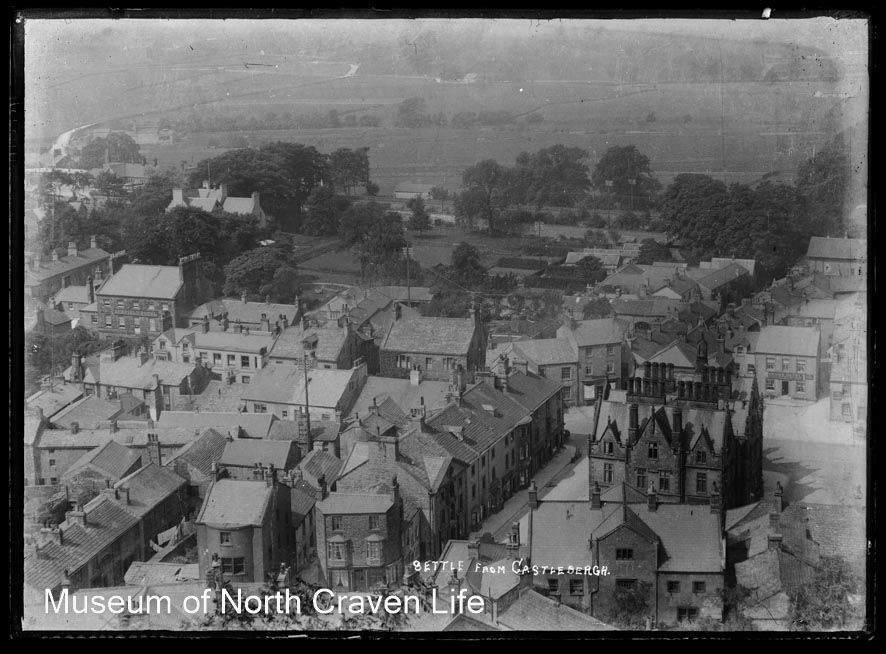
Settle Market Place from Castleberg, Horner Photographic Studio, about 1875 to about 1925, Victorian. The Horner Photographic Collection, Museum of North Craven Life (The Folly), Settle. CC BY 4.0. See the work -
1850
“Within the last century the peak of Castleberg formed the gnomon of a huge sun dial, whose hours were marked along the hill side by large stones ; these have been long removed, and the plantations occupy their site.”
William Howson, Settle guidebook writer. See the page
Source
William Howson, An Illustrated Guide to the Curiosities of Craven (London and Settle, 1850), page 50.
-
1850
“Above the town appears the rock of Castleberg, rising to a height of three hundred feet above the level of the market-place, and backed by a cluster of steep green hills”
William Howson, Settle guidebook writer. See the page
Source
William Howson, An Illustrated Guide to the Curiosities of Craven (London and Settle, 1850), page 49.
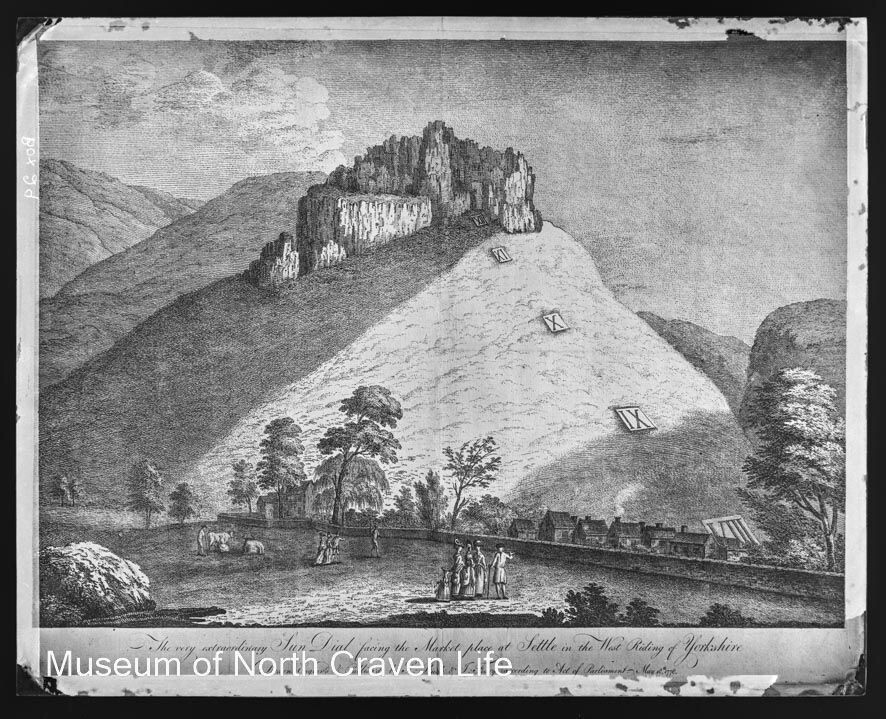
The sundial on Castleberg, from a print of the 1770s, Horner Photographic Studio, about 1858 to about 1885 (the photograph). The Horner Photographic Collection, Museum of North Craven Life (The Folly), Settle. CC BY 4.0. See the work -
1850
“a small gratuity is expected by the person who gives the key for admission.”
William Howson, Settle guidebook writer. See the page
Source and note
William Howson, An Illustrated Guide to the Curiosities of Craven (London and Settle, 1850), page 50.
Howson says the grounds of Castleberg were on a ninety-nine year lease. Paths led through plantations to a seat at the top.
-
1879
“Winding paths lead through pleasant groves to the summit, whence is a fine view of Ribblesdale and the neighbouring hills. As if a fear were entertained that the scenery might be regarded as an insufficient return for the expenditure incurred at the gate of entrance, artificial attractions have been added for the benefit of the young, in the shape of swings, see-saws, and merry-go-rounds.”
J. Radford Thomson, author of a guide to Craven and the new railway. See the page
Source and note
J. Radford Thomson, Guide to the District of Craven and the Settle and Carlisle Railway, second edition (London: Simpkin, Marshall; Settle: H. Gore, 1879), page 47.
Thomson says the grounds were kept locked, and visitors paid a small sum to go in.
-
1892
“From the top of Castleberg, where seats have been placed, the prospect northwards and westwards is exceedingly fine”
Harry Speight, Bingley writer on the Yorkshire dales. See the page
Source
Harry Speight, The Craven and North-West Yorkshire Highlands (London: Elliot Stock, 1892), page 84.