UK · England · North Yorkshire · Craven · Settle and Ribblesdale
Langcliffe

What the writers say
Writers tell stories of its people. Speight passes on a story that Major Dawson built an arbour for Isaac Newton. Another writer tells of a Methodist preacher whose congregation sang on without him when his glasses fell. Howson in 1850 also tells a story that the Scots destroyed a village here. He notes a large cotton mill too.
-
1086
“Manor. In Lanclif (Langcliffe) Fech had three carucates to be taxed.”
Domesday Book, the Conqueror's survey of 1086, in Speight's English. See the page
Source and note
Harry Speight, The Craven and North-West Yorkshire Highlands (London: Elliot Stock, 1892), page 73.
Whitaker (1805, p. 124) calls carucates 'plowlands': land measured for the tax called the geld.
-
1805
“Langcliff, parcel of the possessions of Sallay Abbey, has been, during a century and an half, the property of the Dawsons”
Thomas Dunham Whitaker, historian of Craven. See the page
Source
Thomas Dunham Whitaker, The History and Antiquities of the Deanery of Craven (London, 1805), page 130.
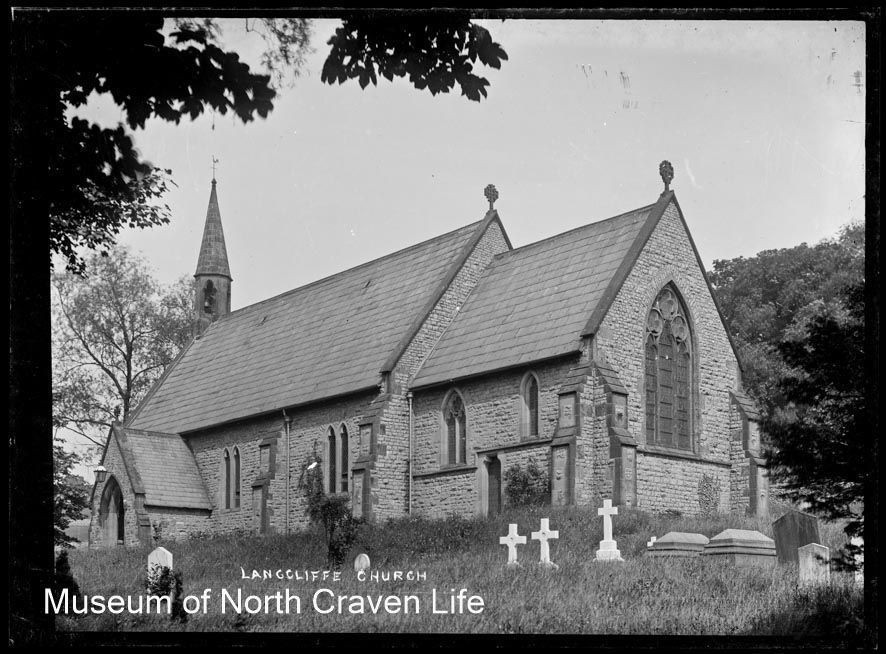
St John the Evangelist, Langcliffe, Horner Photographic Studio, about 1875 to about 1925, Victorian. The Horner Photographic Collection, Museum of North Craven Life (The Folly), Settle. CC BY 4.0. See the work -
1849 · 31 March 1849
“Clayton William, of Langcliffe and Settle, cotton spinner”
Perry's Bankrupt Gazette, a newspaper, in the British Newspaper Archive's free search extract. See the page
Source and note
Perry's Bankrupt Gazette, 31 March 1849, page 5; the words come from the free extract the British Newspaper Archive's search shows, page 5.
From a list of meetings of creditors in Perry's Bankrupt Gazette. The paper lists William Clayton of Langcliffe with two Lancashire bankers.
-
1850
“On the road from Stainforth to Langcliffe are indications of the site of a village said to have been destroyed by an incursion of the Scots ... Opposite is Langcliffe Place, and the large unromantic Cotton Mill.”
William Howson, writer of a Settle guide. See the page
Source
William Howson, An Illustrated Guide to the Curiosities of Craven (London and Settle, 1850), page 62.
-
1863 · March 1863
“So ended the rejoicings at the village of Langcliffe on the marriage of our Prince and the Princess of Denmark.”
Settle Chronicle, the monthly Settle paper. See the page
Source
The Settle Chronicle and North Ribblesdale Advertiser, 1863 volume. Scans held by the Museum of North Craven Life, published by the North Craven Building Preservation Trust (CC BY-NC-SA 4.0), page 19.
-
1892
“The great philosopher is said to have been an occasional visitor of Major Dawson at Langcliffe, who had an arbour purposely constructed in the garden for him”
Harry Speight, author of a guide and history of Craven. See the page
Source and note
Harry Speight, The Craven and North-West Yorkshire Highlands (London: Elliot Stock, 1892), page 114.
The philosopher is Sir Isaac Newton. Speight reports this as hearsay.
-
1892
“Then he turned to the throng saying, "My specs hev fallen and I cannot see," but the congregation undismayed by the incident left him to pick up and adjust his glasses while they with one accord started a hymn for themselves.”
Harry Speight, author of a guide and history of Craven. See the page
Source and note
Harry Speight, The Craven and North-West Yorkshire Highlands (London: Elliot Stock, 1892), page 115.
The preacher is "White-lock Tommy", a Langcliffe tanner and Methodist, preaching on the village green early in the nineteenth century.