UK · England · North Yorkshire · Craven · In Malham
Malham Cove

With children
The cliff in front of you is 286 feet high. Twice in forty years, the tarn up the hill flooded, and its water poured over the top of the cove. William Howson said the water turned into one huge cloud of spray before it reached the bottom.
This story comes from William Howson, writing in 1850, and John Phillips, writing in 1853.
When you get there Find where the water comes out from under the foot of the cliff. In 1853 John Phillips said the river starts here.
What the writers say
Writers compare the Cove to an old wall or the gates of a castle, and they measure it at 285 or 286 feet. They ask whether the River Aire starts at its foot, and they record floods from above pouring over the top.
-
1779 · 20 September 1779
“the stone is very white, and from the ledges hang various shrubs and vegetables”
Adam Walker, lecturer in natural philosophy, writing to the General Evening Post. See the page
Source
Thomas West, A Guide to the Lakes, 2nd edition (London, 1780), Addenda, reprinting the General Evening Post of 25 September 1779, page 236.
-
1780 · first printed 1780
“there pours down a stupendous cataract, in height almost double that of Niagara.”
Rev. J. Hutton, a clergyman touring the caves of the West Riding. See the page
Source and note
Thomas West, A Guide to the Lakes, 2nd edition (London, 1780), Addenda, 'A Tour to the Caves in the West-Riding of Yorkshire', page 266.
West's Guide of 1780 prints it unsigned, as 'A Tour to the Caves ... in a letter to a friend, now first printed'. Speight (1892, p. 84) names the writer as the Rev. J. Hutton.
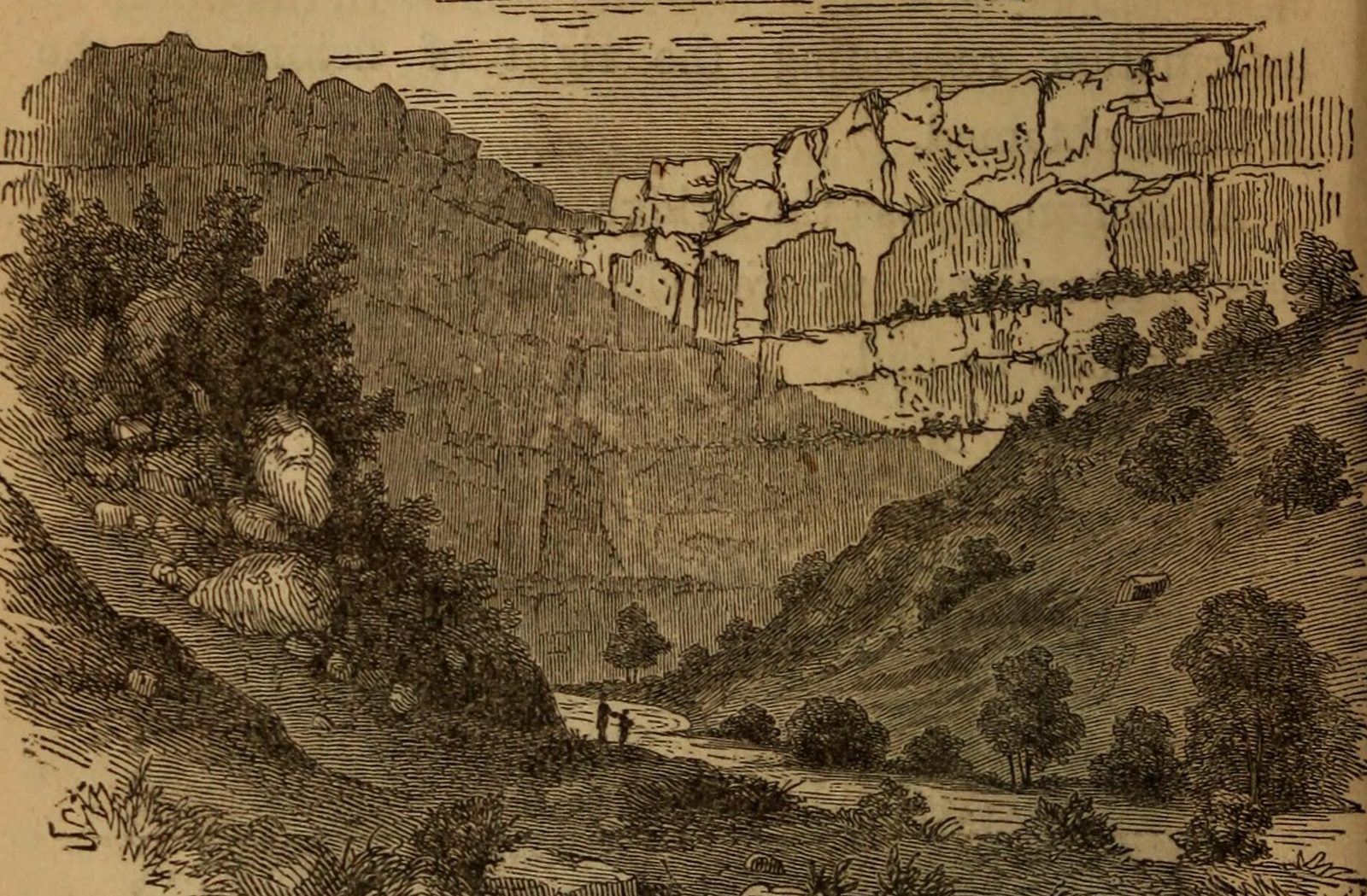
Malham Cove. From William Howson, An Illustrated Guide to the Curiosities of Craven (London: Whittaker; Settle: Wildman, 1850). See the page -
1800
“its fine colour, which gives it the appearance of an old wall of prodigious strength”
John Housman, guidebook writer, touring Craven and the Lakes. See the page
Source
John Housman, A Descriptive Tour, and Guide to the Lakes, Caves, Mountains, and other Natural Curiosities (Carlisle, 1800), page 22.
-
1805
“an immense cragg of limestone, 286 feet high, stretched in the shape of the segment of a large circle across the whole valley”
Thomas Dunham Whitaker, clergyman and historian of Craven. See the page
Source
Thomas Dunham Whitaker, The History and Antiquities of the Deanery of Craven (London, 1805), page 194.
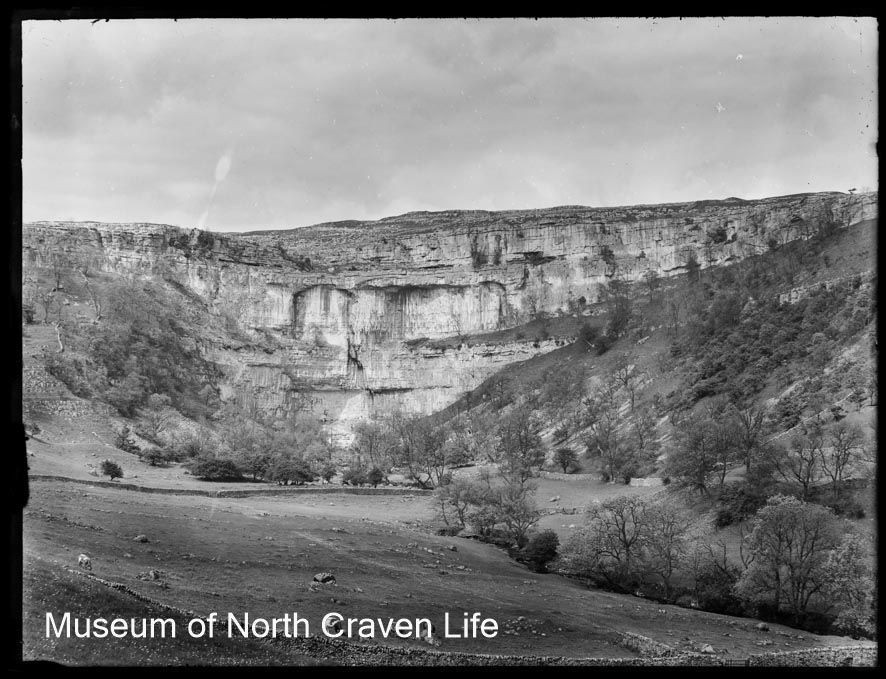
Malham Cove, Horner Photographic Studio, 1890 to 1920, Victorian. The Horner Photographic Collection, Museum of North Craven Life (The Folly), Settle. CC BY 4.0. See the work -
1805
“The approach to this wonderful place was, till the invention of machinery, solitary and characteristic. It is now polluted by one of those manufactories”
Thomas Dunham Whitaker, clergyman and historian of Craven. See the page
Source
Thomas Dunham Whitaker, The History and Antiquities of the Deanery of Craven (London, 1805), page 194.
-
1850
“Twice within the last forty years the swollen waters of the Tarn have made their way over the Cove, but the torrent was dispersed in one vast cloud of spray before it reached the bottom”
William Howson, Settle guidebook writer. See the page
Source
William Howson, An Illustrated Guide to the Curiosities of Craven (London and Settle, 1850), page 38.
-
1850
“the Cove rearing its magnificent front to the height of two hundred and eighty six feet, and stretching across the valley like the gigantic portals of a fabulous castle.”
William Howson, Settle guidebook writer. See the page
Source
William Howson, An Illustrated Guide to the Curiosities of Craven (London and Settle, 1850), page 37.
-
1853
“Airedale has an origin quite unlike that of any other great Yorkshire dale, for its river springs at once, a full stream, from under a huge cliff of limestone called Malham Cove, 285 feet in height.”
John Phillips, geologist. See the page
Source
John Phillips, The Rivers, Mountains, and Sea-Coast of Yorkshire (London, 1853), page 92.
-
1858
“From a distance you might well imagine it to be a towering ruin”
A visitor writing in the Settle Chronicle, walking from Settle to Malham. See the page
Source
The Settle Chronicle and North Ribblesdale Advertiser, 1858 volume. Scans held by the Museum of North Craven Life, published by the North Craven Building Preservation Trust (CC BY-NC-SA 4.0), page 33.
-
1858
“while you look up at its pale marble-like surface, broken only by a narrow shelf - a stripe of green-accessible to goats and adventurous boys”
A visitor writing in the Settle Chronicle, walking from Settle to Malham. See the page
Source
The Settle Chronicle and North Ribblesdale Advertiser, 1858 volume. Scans held by the Museum of North Craven Life, published by the North Craven Building Preservation Trust (CC BY-NC-SA 4.0), page 33.
-
1889 · 27 April 1889
“Tremendous freak of Nature, nobly grand”
Horwich Chronicle, a newspaper, in the British Newspaper Archive's free search extract. See the page
Source and note
Horwich Chronicle, 27 April 1889, page 5; the words come from the free extract the British Newspaper Archive's search shows, page 5.
From Yorkshire Sonnets, No. 1, which the paper printed.


