William Boyd Dawkins
Geologist and cave hunter, professor of geology at Owens College, Manchester
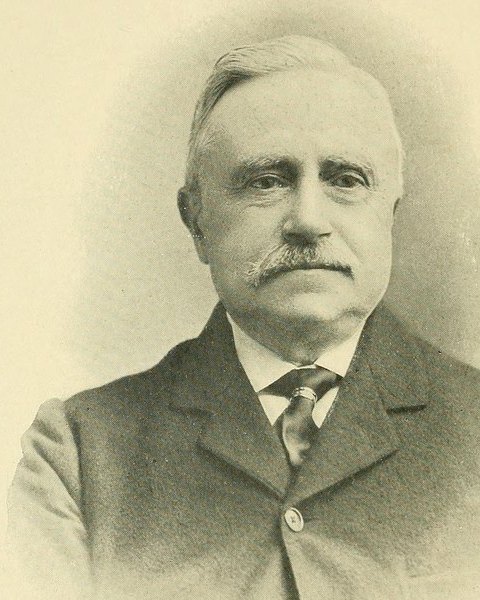
Who they were
Dawkins was born at Buttington Vicarage, near Welshpool, on 26 December 1838.
From Thompson Cooper, "Dawkins, William Boyd", Men of the Time, eleventh edition (1884): “was born Dec. 26, 1838, at Buttington Vicarage, Welshpool, Montgomeryshire” See the page
He went to Rossall School and then to Jesus College, Oxford.
From Thompson Cooper, "Dawkins, William Boyd", Men of the Time, eleventh edition (1884): “He received his education at Rossall school and at the University of Oxford, where he became a scholar of Jesus College” See the page
He joined the Geological Survey in 1862.
From Thompson Cooper, "Dawkins, William Boyd", Men of the Time, eleventh edition (1884): “He was appointed assistant geologist in Her Majesty's Geological Survey of Great Britain in 1862” See the page
He became curator of the Manchester Museum in 1869. Owens College, Manchester, made him its professor of geology in 1874.
From Thompson Cooper, "Dawkins, William Boyd", Men of the Time, eleventh edition (1884): “Curator of the Manchester Museum, 1869; lecturer on geology in Owens College, Manchester, in 1870; Professor there in 1874” See the page
In 1875 he went round the world, by way of Australia and New Zealand.
From Thompson Cooper, "Dawkins, William Boyd", Men of the Time, eleventh edition (1884): “In 1875 he went round the world, by way of Australia and New Zealand.” See the page
In 1882 he surveyed the English and French coasts for the first Channel Tunnel.
From Thompson Cooper, "Dawkins, William Boyd", Men of the Time, eleventh edition (1884): “He was appointed, in 1882, a member of the scientific committee of the Channel Tunnel, and entrusted with the geological survey of the English and French coasts for that enterprise.” See the page
His chief fame came from his study of the people who lived in caves before history.
From "Dawkins, William Boyd", Encyclopaedia Britannica, eleventh edition, vol. 7 (1910): “His chief distinctions, however, were won in the realms of anthropology by his researches into the lives of the cave-dwellers of prehistoric times” See the page
He died at his home in Bowdon, Cheshire, in January 1929, aged 91. By then he was Sir William.
From Sunderland Daily Echo and Shipping Gazette, 16 January 1929, page 7, British Newspaper Archive free extract: “Sir William Boyd Dawkins, Hon. Professor of Geology and Palaeontology in Victoria University, Manchester, died at Richmond Lodge, Bowdon, yesterday. Sir William, who was 91” See the page
In Craven
In 1870 gentlemen from round Settle formed a committee to dig the Victoria Cave.
From W. Boyd Dawkins, Cave Hunting: Researches on the Evidence of Caves Respecting the Early Inhabitants of Europe (London: Macmillan, 1874), page 85: “until, in 1870, Sir James ... and other gentlemen in the neighbourhood formed a committee for the investigation of the contents of the cave” See the page
Dawkins identified the animal bones the diggers found. He wrote the committee's reports for 1870, 1871 and 1872.
From W. Boyd Dawkins, Cave Hunting: Researches on the Evidence of Caves Respecting the Early Inhabitants of Europe (London: Macmillan, 1874), page 85: “the mammalian remains that were discovered, and drew up for the committee the reports brought before the British Association in 1870, 1871, and 1872” See the page
He gave the Victoria Cave a large place in his book Cave Hunting, in 1874.
From W. Boyd Dawkins, Cave Hunting: Researches on the Evidence of Caves Respecting the Early Inhabitants of Europe (London: Macmillan, 1874), Preface: “I have given considerable prominence to the exploration of the Victoria Cave, near Settle” See the page
7 quotes on 3 places
A bigger dot means more quotes. Tap a dot to open the place.
What they wrote
-
Victoria Cave, and 3 more
1874
“some brooches of singular taste and beauty, with implements of bone, and large quantities of broken bones and fragments of pottery”
W. Boyd Dawkins, geologist who identified the cave's finds for its excavation committee. See the page
Source
W. Boyd Dawkins, Cave Hunting: Researches on the Evidence of Caves Respecting the Early Inhabitants of Europe (London: Macmillan, 1874), page 83.
-
Alum Pot, and 1 more
1874
“ventured into this awful chasm with no other apparatus than ropes, planks, a turn-tree, and a fire-escape belt.”
William Boyd Dawkins, geologist and cave explorer. See the page
Source and note
Cave Hunting: Researches on the Evidence of Caves (London: Macmillan, 1874), page 43.
Dawkins means the party of ten who made the first descent, in 1847.
-
1874
“Its circumference in 1839 measured 118 inches, in 1845, 120 inches, and in 1873, I found it to be 128 inches.”
William Boyd Dawkins, geologist and cave explorer. See the page
Source and note
Cave Hunting: Researches on the Evidence of Caves (London: Macmillan, 1874), page 39.
'It' is the Jockey Cap, a stalagmite in the cave.