UK · England · North Yorkshire · Craven · Skipton and Airedale
Skipton
What the writers say
Whitaker says the name means the town of sheep. Jurors in 1362 recorded a Sunday market and two fairs a year. Gray in 1769 saw one broad street running down from the castle, but sleet and a quarrel about carriages kept him from going in. Lady Anne Clifford wrote that she rebuilt the castle after Cromwell ordered it pulled down. She wrote that she could not have a lead roof.
-
1362 · 13 August 1362
“And there is there a certaine markett held euery yeare on the Sabboth day euery weeke, and two faires held by the yeare in the feasts of Saint Martin in winter and of Saint James the Apostle”
An inquisition taken at Skipton, jurors valuing the castle and manor after Isabella de Clifford's death. See the page
Source and note
William Harbutt Dawson, History of Skipton (London and Skipton, 1882), page 28.
Dawson prints the inquisition in a later English translation. The inquisition dates from the 36th year of Edward III. The Sabbath here is Sunday.
-
1657
“which Roomes were all Covered over with slate about Michellmas also, with Gutters of Leade about the Roomes thatt are Covered with slate, ffor I was not permitted to cover it with Leade”
Lady Anne Clifford, heiress of Skipton Castle, in her own record of her life. See the page
Source and note
George C. Williamson, Lady Anne Clifford, Countess of Dorset, Pembroke and Montgomery, 1590-1676 (Kendal, 1922), page 420.
Williamson's footnote says the ban on a lead roof was to stop anyone mounting cannon on it.
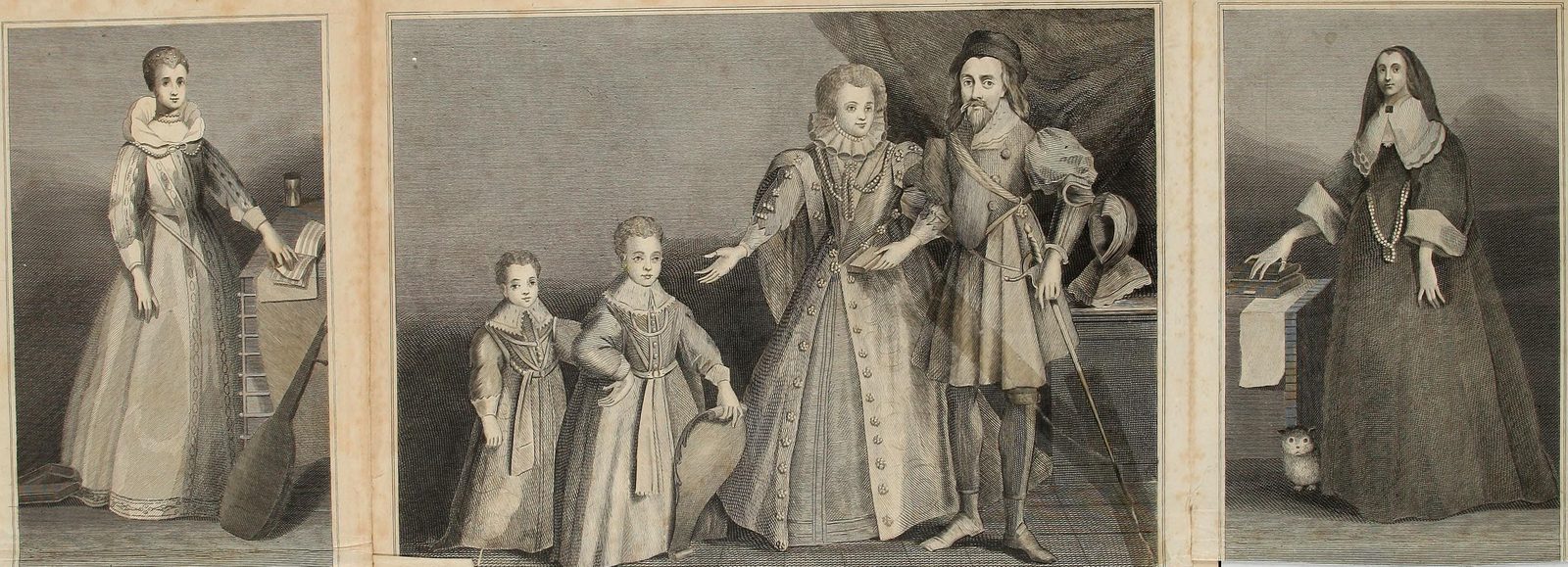
Portrait of George Earl of Cumberland & his Family at Skipton Castle. From Thomas Dunham Whitaker, The History and Antiquities of the Deanery of Craven (London, 1805). See the page -
1663 · 6 May 1663
“for though thatt and the chiefe parts of the castle were pulled down by command of Cromwell in 1648, yet did I cause it to be rebuilt as it now is in the yeres 1657, 58 and 59”
Lady Anne Clifford, heiress of Skipton Castle, in her own record of her life. See the page
Source
George C. Williamson, Lady Anne Clifford, Countess of Dorset, Pembroke and Montgomery, 1590-1676 (Kendal, 1922), page 420.
-
1732 · about 1732
“and so down a dismal large Mountain or Precipice to this beautiful Town”
Thomas Gent, York printer and historian, on a visit to Skipton. See the page
Source and note
William Harbutt Dawson, History of Skipton (London and Skipton, 1882), page 4.
Dawson, writing in 1882, says Gent wrote this 'a hundred and fifty years ago', so about 1732. We have not found Gent's own book.
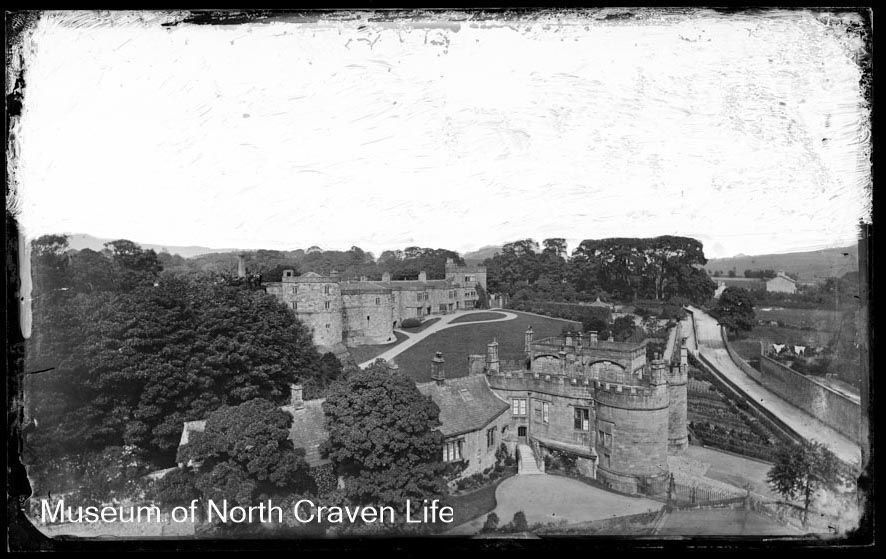
Skipton Castle from above, Horner Photographic Studio, about 1858 to about 1885. The Horner Photographic Collection, Museum of North Craven Life (The Folly), Settle. CC BY 4.0. See the work -
1769 · 15 October 1769
“what with the sleet and a foolish dispute about chaises that delayed me, I did not see the inside of it”
Thomas Gray, poet, on a tour of the north. See the page
Source
The Letters of Thomas Gray, ed. Duncan C. Tovey, vol. III (London: G. Bell and Sons, 1912), Gray's journal of his tour, page 263.
-
1769 · 15 October 1769
“it is a pretty large market town in a valley with one very broad street gently sloping downwards from the Castle, which stands at the head of it”
Thomas Gray, poet, on a tour of the north, keeping a journal for his friend Dr Wharton. See the page
Source
The Letters of Thomas Gray, ed. Duncan C. Tovey, vol. III (London: G. Bell and Sons, 1912), Gray's journal of his tour, page 263.
-
1805
“perhaps there is no English character so frequently and so copiously recorded in stone and marble as the countess of Pembroke”
Thomas Dunham Whitaker, clergyman and historian of Craven. See the page
Source and note
Thomas Dunham Whitaker, The History and Antiquities of the Deanery of Craven (London, 1805).
The countess of Pembroke is Lady Anne Clifford, who rebuilt Skipton Castle and put her name on her buildings.
-
1805
“in Domesday,, and in all the early charters I have seen, the word is spelt Sciptone, Sceptone, or Scepetone ; evidently from the Saxon Seep, a Sheep. Skipton, therefore, is the Town of Sheep”
Thomas Dunham Whitaker, clergyman and historian of Craven. See the page
Source and note
Thomas Dunham Whitaker, The History and Antiquities of the Deanery of Craven (London, 1805).
The scan prints two commas after Domesday, and 'Seep' where Whitaker set the Saxon letter for sc.
-
1831 · 28 March 1831
Skipton, Linton, Addingham and Carlton petitioned Parliament in 1831 to end slavery in the colonies.
“of Skipton;—of Linton ... of Addingham ... of Carlton-in-Craven ... praying for the Abolition of Colonial Slavery”
Journals of the House of Commons, Parliament's own record of each day's business. See the page
Source and note
Journals of the House of Commons, vol. 86, 14 September 1830 to 22 November 1831, page 444.
Skipton, Linton, Addingham and Carlton-in-Craven all sent petitions on the same day as Earby and Barnoldswick.
-
1856 · September 1856
“The show took place in the field behind the Castle. The field is the best for the purpose we ever saw ; situated on high ground, it affords some splendid views of the neighbouring hills and vales”
Settle Chronicle, the monthly Settle paper. See the page
Source and note
The Settle Chronicle and North Ribblesdale Advertiser, 1856 volume. Scans held by the Museum of North Craven Life, published by the North Craven Building Preservation Trust (CC BY-NC-SA 4.0), page 39.
The second show of the Craven Agricultural Society, on Friday 12 September 1856.
-
1876 · 23 December 1876
The Jubilee Singers, students who had been enslaved, came to Skipton from Nashville, Tennessee.
“THE JUBILEE SINGERS, Emancipated Slaves, Students of ... University, Nashville, Tennessee, U.S.A., will give a SERVICE OF SONG”
Craven Herald, the Skipton weekly paper. See the page
Source and note
Craven Herald, 23 December 1876, page 1; the words come from the free extract the British Newspaper Archive's search shows, page 1.
An advertisement for the singers' visit to Skipton in January 1877. The scan's text reads 'Fuk University'. The advertisement names the American Missionary Association and the Freedmen's Mission Aid Society.
-
1877 · 1 January 1877
The Jubilee Singers sang in Skipton's Wesleyan Chapel on New Year's Day, 1877.
“The popular troupe of emancipated slaves, known by the name of the Jubilee Singers, gave their Service of Song in the Wesleyan Chapel on Monday evening last. The chapel had been very generously placed at the disposal of the Singers”
Craven Herald, the Skipton weekly paper. See the page
Source and note
Craven Herald, 6 January 1877, page 4; the words come from the free extract the British Newspaper Archive's search shows, page 4.
The paper came out on Saturday 6 January 1877, so 'Monday evening last' was New Year's Day.
-
1879 · February 1879
A second band of Jubilee Singers, from North Carolina, sang in Skipton in 1879.
“the above band of Jubilee Singers from North Carolina ... Skipton The band is composed of the following”
Craven Herald, the Skipton weekly paper. See the page
Source and note
Craven Herald, 22 February 1879, page 4; the words come from the free extract the British Newspaper Archive's search shows, page 4.
A second group of singers came to Skipton two years after the first. The scan's text of the heading is too damaged to read, so we do not give the group's own name. The report goes on to list the band, but the free extract stops first.
Visit
From the guide. Nobody pays to be here.
The Devonshire, Skipton
The Devonshire is an eighteenth-century coaching house on Newmarket Street, now a Wetherspoon pub.
“Inns at Skipton, the Devonshire Hotel, and the Black Horse.”
William Howson, 1850. See the page
Skipton Castle
Skipton Castle is a medieval castle at the top of the High Street.
Craven Museum, Skipton Town Hall
Craven Museum is a free museum in Skipton Town Hall on the High Street.
Leeds and Liverpool Canal
The Leeds and Liverpool Canal crosses Pennine country on the edge of the Dales.